
Trump Tells Ukraine to Stop Blowing Up Diesel Because Diesel Has Become Expensive
White House asks Kyiv to consider how defending itself affects people with boats
By Thurston P. Bootstrap IV, Senior Petroleum Peace Correspondent
The Daily Hyperbole | September 14, 2026 | SATIRE
WASHINGTON, D.C. — President Donald Trump urged Ukraine to stop attacking Russian diesel infrastructure this week after discovering that destroying an adversary’s fuel supply can reduce the amount of fuel the adversary has available to sell.
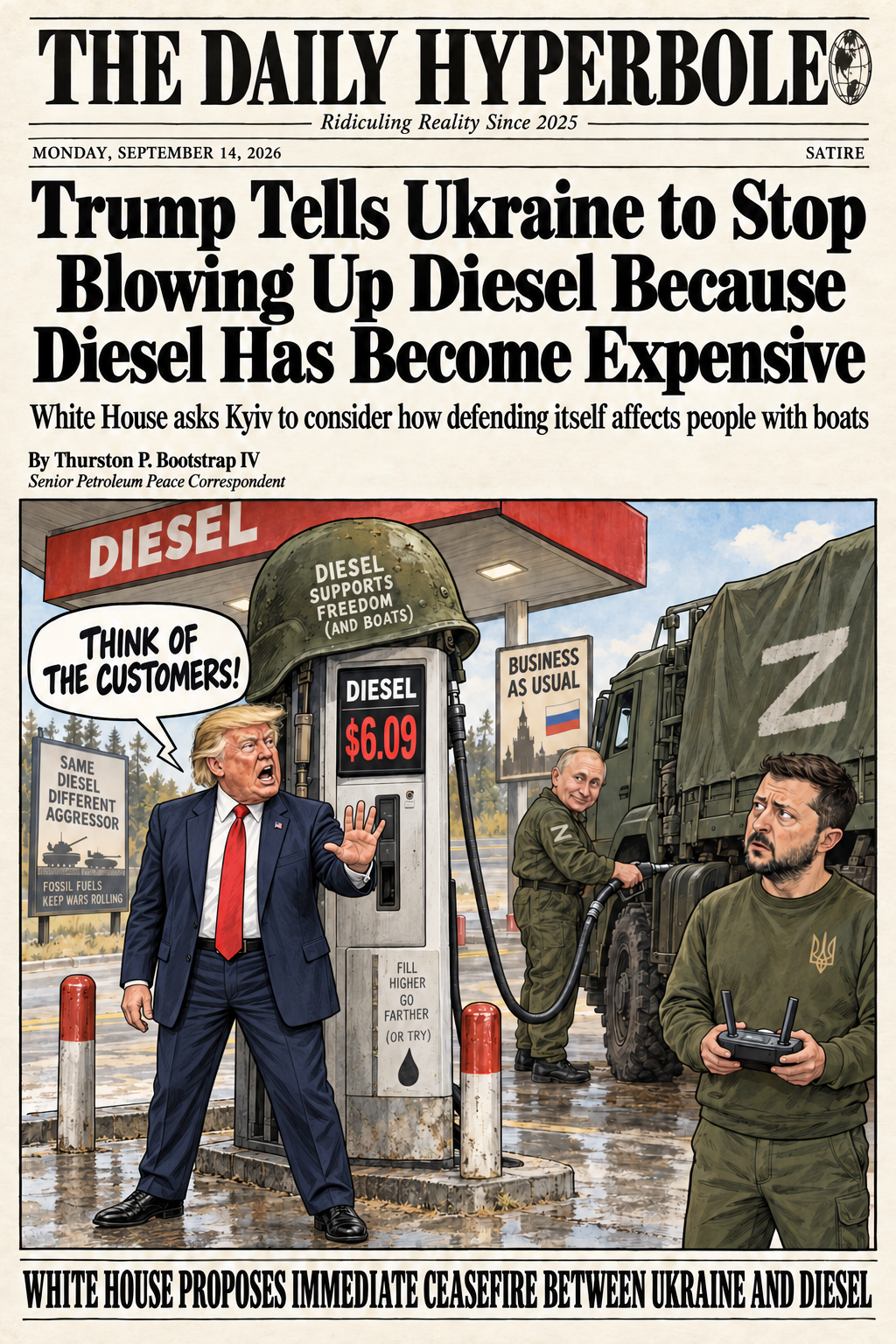
The president reportedly arrived at the conclusion after reviewing a classified intelligence document consisting of a photograph of a gas station sign.
“Look at that number,” Trump said, pointing to the diesel price. “Before the explosions, there was more diesel. Now there’s less. I don’t know why nobody at NATO figured this out.”
Under the administration’s proposed approach, Ukraine would continue to possess the right to defend itself, provided it selected targets with minimal exposure to international commodity markets.
A new Pentagon targeting checklist reportedly asks Ukrainian commanders to establish whether a proposed strike would degrade Russian military capabilities, disrupt supply lines, or make a man in Ohio complain while filling his truck.
The third question is underlined.
“We understand Ukraine wants to increase the cost of the invasion,” said a fictional administration official. “Unfortunately, some of that cost has reached customers.”
The Kremlin welcomed the initiative, praising the emerging international consensus that the Russian economy should be protected from the economic consequences of Russian foreign policy.
A spokesman said Moscow had always supported peace around refineries and hoped the principle could eventually be extended to ammunition factories, military airfields, and whichever bridge Ukraine was looking at.
In Kyiv, officials were reportedly instructed to submit a revised list of targets that Russia would miss emotionally but that markets would barely notice.
Early proposals included an empty conference room, a commemorative plaque, and the printer responsible for producing invasion maps.
The printer was subsequently removed from consideration after an adviser warned of potential disruption to European toner prices.
Meanwhile, American diplomats began drafting a framework under which each Ukrainian drone would carry an environmental impact statement, a price forecast, and a brief apology to the American Trucking Associations.
Negotiators described the framework as a breakthrough because it established, for the first time, precisely how much sovereignty could be defended per gallon.
At press time, the White House had proposed an immediate ceasefire between Ukraine and diesel.