
Trump Threatens Iran With WWII-Level CAPS LOCK
Pentagon confirms lowercase letters remain in strategic reserve
By Thurston P. Bootstrap IV, Senior War and Peace Correspondent
WASHINGTON, D.C. — President Donald Trump escalated tensions with Iran late Saturday by deploying levels of CAPS LOCK not seen since World War II, unleashing a concentrated barrage of capital letters across Truth Social and placing the entire Persian Gulf on heightened typographical alert.
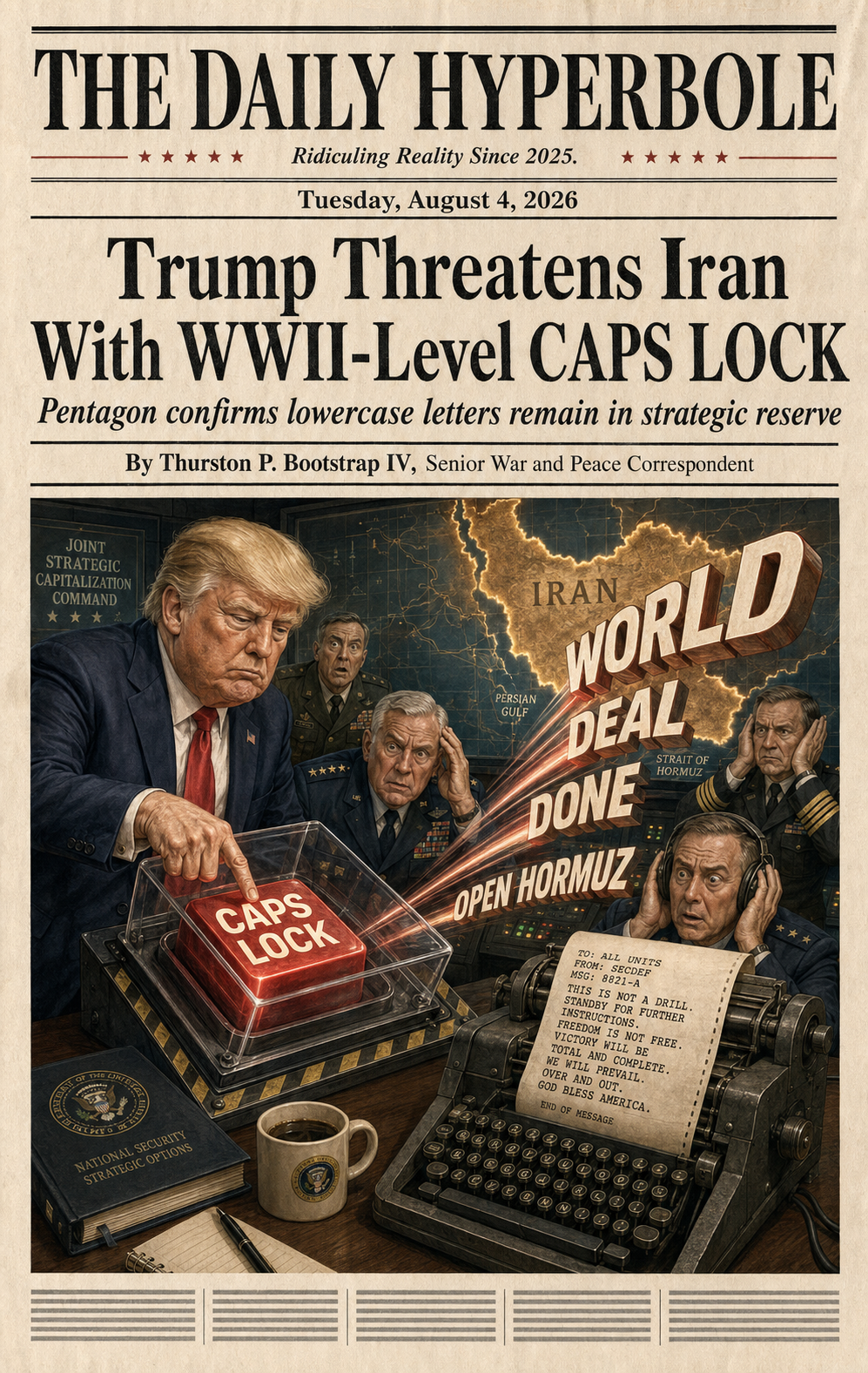
The offensive began when Trump announced that the United States was “locked and loaded” with unprecedented levels of “Military Terror, Strength, and Power,” before striking several additional targets with the phrases “OPENING OF THE HORMUZ STRAIT,” “WORLD,” “DEAL,” and “DONE.”
Pentagon officials described the post as a calibrated show of formatting superiority.
“This was not random capitalization,” said Brig. Gen. Arial Black, deputy commander of U.S. Strategic Fonts. “Each capital letter was selected, enlarged, and deployed to achieve maximum deterrence while minimizing the risk of an accidental paragraph break.”
Black emphasized that the United States still possesses a massive reserve of boldface, italics, underlining, and exclamation points that could be activated if Iran refuses to comply.
“The president used CAPS LOCK, but he did not use bold CAPS LOCK,” Black said. “That distinction is the only reason anyone in Tehran slept last night.”
Historians noted that Trump’s comparison to World War II was unusually accurate. During the war, a great deal of military message traffic traveled through telegram and teletype systems that frequently printed only capital letters. Commanders were not necessarily shouting; their equipment simply had no lowercase setting.
“In 1944, ALL CAPS meant your message had passed through a teleprinter,” explained Dr. Beatrice Kerning, professor of Strategic Typography at Georgetown University. “Today, it means the president would like another country to reconsider its afternoon.”
Kerning added that the U.S. Navy did not begin moving away from its all-capital message tradition until 2013, roughly 68 years after World War II ended, demonstrating that once the federal government discovers an aggressive formatting choice, it can take several generations to turn it off.
Iranian defense officials reportedly scrambled to assess the threat after the post appeared, initially mistaking the capitalized words for multiple incoming weapons systems.
“We had prepared for aircraft carriers, cruise missiles, cyberattacks, and economic sanctions,” said one Iranian official speaking on condition of readability. “We were not prepared for the president to capitalize WORLD.”
Iran’s Ministry of Defense has since moved senior officials into a reinforced font bunker and ordered government communications to remain in Times New Roman until the crisis passes. Intelligence analysts believe Tehran could retaliate with a strongly worded statement in 14-point bold, though officials cautioned that Iran does not currently possess America’s stockpile of premium typefaces.
At the center of the dispute is the Strait of Hormuz, which Trump demanded be opened immediately, completely, and totally. Maritime authorities confirmed Sunday that the strait was already a narrow body of water and did not appear to have hinges, though crews have been dispatched to install a giant illuminated OPEN sign as a gesture of good faith.
“The Strait of Hormuz is open for business,” said Rear Adm. Chip Wakefield. “Ships may proceed in an orderly fashion, remove their caps upon entering, and refrain from making any sudden punctuation.”
The White House said Trump had canceled an unspecified attack after Iran and several Middle Eastern countries agreed to the preliminary outlines of a deal. Officials declined to describe the canceled operation but confirmed that it would have involved “an absolutely devastating amount of formatting.”
Israel has joined the commitment and reportedly contributed several pallets of emergency boldface to the negotiations. Britain offered to provide proper punctuation, but the proposal was rejected as unnecessarily provocative.
Members of Congress are now debating whether the president requires authorization under the War Powers Resolution before launching sustained typographical operations against a foreign country.
“The Constitution clearly gives Congress the power to declare war,” said Sen. Martin Quibble (D-Mass.). “It is less clear who has the authority to capitalize ordinary nouns until they become national-security objectives.”
Republicans dismissed those concerns, arguing that the commander in chief has inherent authority to deploy capital letters whenever American interests or oil prices are threatened.
Negotiators said a final agreement could require Iran to reopen the Strait of Hormuz, abandon its nuclear threat, and formally recognize the superior range of the American keyboard. In exchange, the United States may reduce its communications posture from ALL CAPS to Title Case, while retaining the right to return to bold italics without warning.
Officials cautioned that the talks remain fragile and could collapse if either side accidentally touches the Shift key.
“The president wants peace,” a White House spokesperson told reporters. “BUT AMERICA IS PREPARED TO FORMAT OTHERWISE.”