
Scientists Narrow Cause of Being Gay to Genetics, Environment, and One Extremely Supportive Art Teacher
By Dr. Cassandra Mockingbird
Senior Correspondent for Human Development & Suspiciously Well-Decorated Classrooms
BOSTON — After decades of research into the origins of sexual orientation, scientists announced Friday that they have narrowed the cause of being gay to a complex interaction between genetics, environmental factors, and one extremely supportive art teacher who kept saying things like, “There are no mistakes in self-expression.”
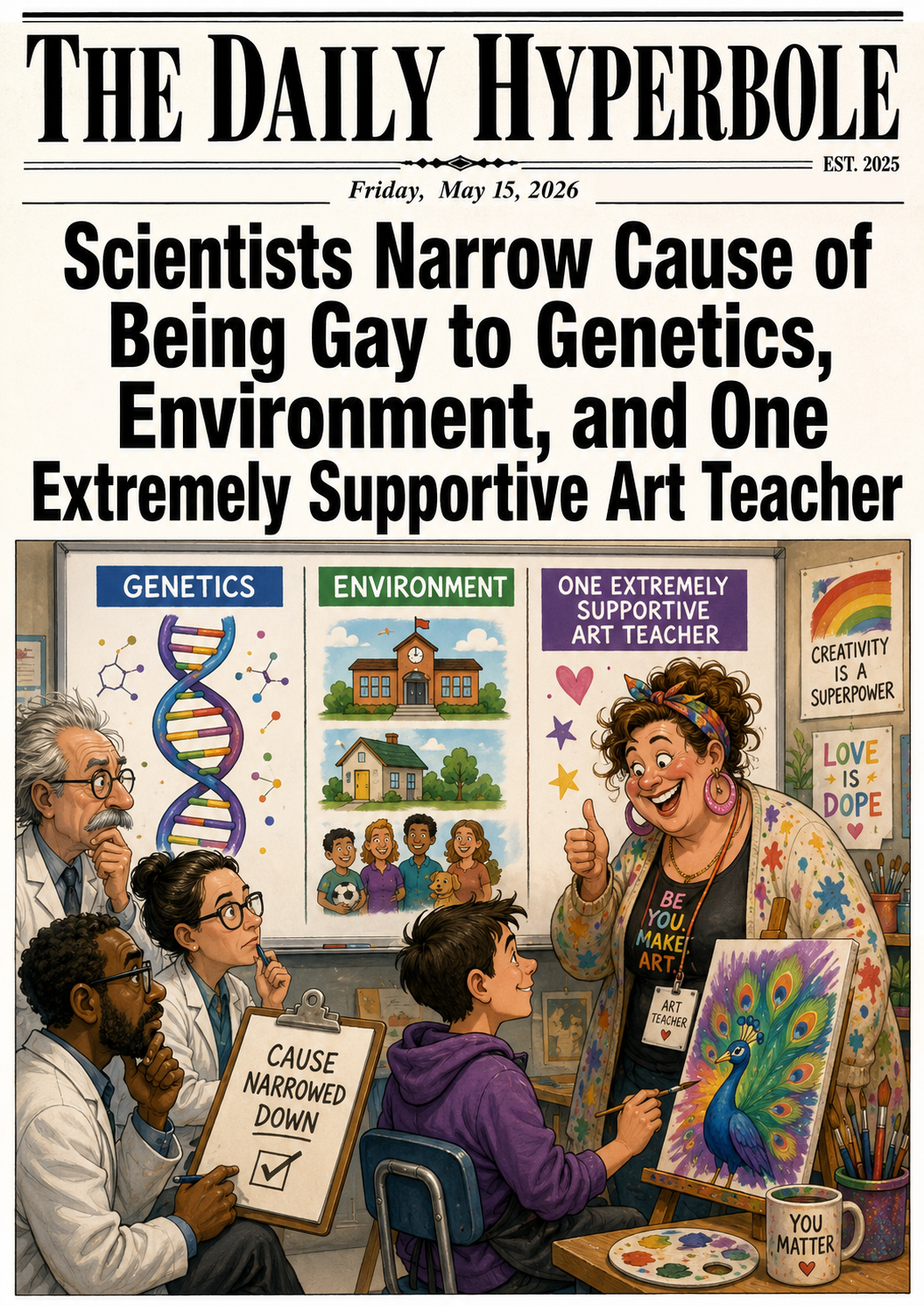
The findings, published in the Journal of Things Everyone Has Been Weirdly Obsessed With Explaining, suggest that homosexuality cannot be attributed to any single gene, household influence, or childhood experience — though researchers conceded that Ms. Linda Pappas of Room 214 “certainly did not hurt.”
“We’ve known for some time that human sexuality is shaped by many biological and developmental factors,” said lead researcher Dr. Nolan Graves. “What we did not anticipate was the statistically significant role played by a middle school art teacher who made eye contact, praised emotional honesty, and once told a 12-year-old boy that his watercolor peacock had ‘real movement.’”
According to the study, individuals who later identified as gay were modestly more likely to have encountered at least one adult during adolescence who encouraged them to “be themselves,” “follow their creative instincts,” or “not worry about what the football boys think.”
“This is not causation,” Graves cautioned. “But the correlation became difficult to ignore after the third participant described being permanently changed by an art teacher who wore large turquoise earrings and played Joni Mitchell during independent work time.”
The report has already sparked controversy among parents, lawmakers, and several school districts now considering restrictions on kiln access, emotional validation, and mixed-media projects involving feathers.
“We always suspected something was going on in the arts wing,” said one concerned father at a school board meeting. “My son went in there making ashtrays and came out with opinions on window treatments.”
Conservative advocacy groups responded swiftly, demanding transparency about “the classroom-to-Broadway pipeline” and calling for congressional hearings into whether positive reinforcement could be “confusing children into having excellent taste.”
Art teachers nationwide rejected the implication that they were responsible for turning students gay, noting that their primary responsibilities remain underfunding, glitter containment, and convincing administrators that papier-mâché is a legitimate educational expense.
“I don’t make anyone gay,” said Pappas, reached while rinsing tempera paint out of a sink. “I just tell kids their ideas matter, their feelings are valid, and that maybe the horse in their drawing could use longer eyelashes if that’s what feels right.”
Still, researchers say the supportive-art-teacher variable may help explain longstanding mysteries in the field, including why certain students gravitate toward drama club, why some children instinctively know a room needs a lamp, and why one boy in every fifth-grade class becomes spiritually invested in the school production of Annie.
The study also identified several lesser contributing factors, including genetics, peer relationships, hormonal development, and exposure to a substitute teacher who once said, “Honestly? You have star quality.”
By Friday afternoon, the Department of Education had issued a statement urging the public not to panic.
“Sexual orientation is a normal part of human diversity and is not caused by any single classroom interaction,” the statement read. “That said, parents should be aware that arts education may lead to confidence, empathy, and an alarming willingness to accessorize.”
At press time, researchers were beginning a follow-up study into whether bisexuality may be linked to genetics, environment, and one unusually intense semester abroad.