
Adidas Unveils Shoe Capable Of Making You Feel Bad About Yourself Faster
By Trent Carbonplate, Footwear Shame Correspondent
LONDON —
The company’s newest racing shoe helped break the two-hour marathon barrier and is expected to help regular people discover exciting new forms of personal inadequacy.
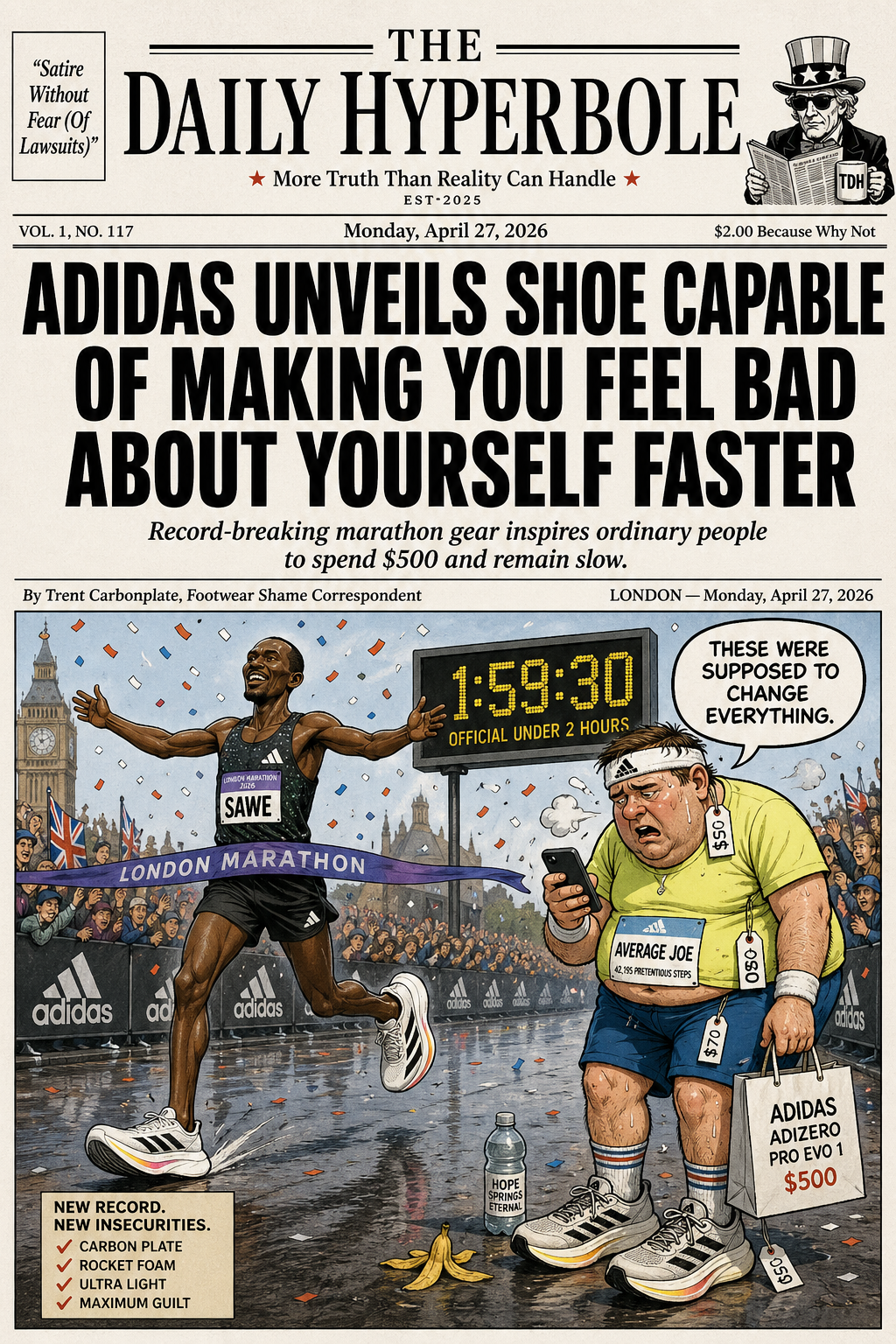
Following Sabastian Sawe’s historic sub-two-hour marathon, Adidas confirmed Monday that its latest super-shoe technology had successfully advanced humanity’s oldest dream: making recreational runners feel worse about themselves at unprecedented speed.
The ultra-light racing shoe, reportedly weighing less than most people’s commitment to cardio, was hailed by experts as a breakthrough in athletic engineering, carbon plate optimization, and consumer guilt.
“This isn’t just a shoe,” said one Adidas spokesperson, standing beside a wind tunnel, three scientists, and a man whose only job appeared to be nodding at foam. “It’s a bold step forward in reminding ordinary people that even with the best equipment available, the problem may still be them.”
The record-breaking performance shocked the running world, as Sawe crossed the finish line in under two hours while millions of viewers at home struggled to stand up from the couch without making a small noise.
Sports analysts immediately praised the achievement as a triumph of human endurance, disciplined training, elite genetics, and footwear technology so advanced that several amateur runners briefly wondered whether they, too, could become world-class athletes by clicking “Add to Cart.”
“Obviously, Sabastian Sawe is one of the greatest runners alive,” said Dr. Harold Stridewell, a professor of biomechanics at the Institute for People Who Say ‘Cadence’ Too Much. “But the shoe also plays an important role, specifically by allowing men in their mid-thirties to believe they are one purchase away from greatness.”
Within minutes of the race, running forums were flooded with posts from recreational athletes asking whether the new Adidas model would help them break four hours in the marathon, improve their 5K time, or finally become the kind of person who owns a foam roller and actually uses it.
According to Adidas, the shoe features a state-of-the-art carbon plate, ultralight mesh, advanced energy return foam, and a patented “Reality Compression System” that briefly convinces buyers their main obstacle is equipment rather than sleep, diet, consistency, or the six beers they had Saturday night.
“We engineered this shoe to help elite runners reach the absolute limits of human performance,” the Adidas spokesperson added. “We also engineered it to help casual runners spend $500 and then blame humidity.”
Retailers reported immediate demand, especially among customers who have not run since Thanksgiving but describe themselves as “training adjacent.”
“I saw the record and knew I had to get them,” said local runner Mark Lafferty, who owns seven pairs of racing shoes and one pair of knees. “People don’t understand that I’m a completely different athlete when I’m wearing carbon plates. My breathing is still terrible, but now it sounds more expensive.”
Lafferty later clarified that he does not currently have a race scheduled, but is “thinking seriously about maybe signing up for something in the fall, depending on vibes.”
The shoe’s launch has also sparked concern among everyday joggers who worry the technology may widen the gap between elite athletes and people who pause their watch at traffic lights, water fountains, and emotionally difficult hills.
“It used to be enough to just run,” said recreational marathoner Denise Calhoun. “Now every group run has some guy explaining stack height, heel drop, lactate threshold, and why his 9:45 pace is actually part of a larger strategy.”
Adidas denied accusations that the shoe is primarily designed to exploit consumer insecurity, insisting that it is merely “providing performance solutions to anyone brave enough to confront their own mediocrity.”
“Our mission is simple,” said the spokesperson. “We want every athlete, from Olympic champions to people who jog once and post the map, to feel like they are participating in the future of sport.”
Meanwhile, economists predicted the record could generate millions in new shoe sales, smartwatch upgrades, compression sock purchases, and race entries from Americans who will begin training programs with fierce intensity before quietly abandoning them after one rainy Tuesday.
The historic marathon has already inspired dramatic changes across the fitness industry. Gyms are reportedly preparing new promotional campaigns reading, “He Ran 26.2 Miles In Under Two Hours. You Can Probably Make It Here Twice This Week.” Peloton instructors have begun referring to normal stationary bike rides as “legacy-defining events.” Several wellness influencers have claimed the sub-two-hour barrier was actually broken because of breathwork, sunlight exposure, and avoiding seed oils.
At press time, Adidas confirmed it was already developing an even lighter shoe for 2027, designed to help elite runners shave another 11 seconds off the marathon record and help amateur runners confidently explain why their last race “wasn’t really about time.”