
Canadian Wildfire Smoke Crosses Border Without Proper Documentation
By Gale Force-Windsor, Border Weather Correspondent
BOSTON, MA — Federal officials confirmed Thursday that a massive cloud of Canadian wildfire smoke entered the United States without a passport, visa, work permit, customs declaration, or even the basic courtesy of stopping at a designated border checkpoint.
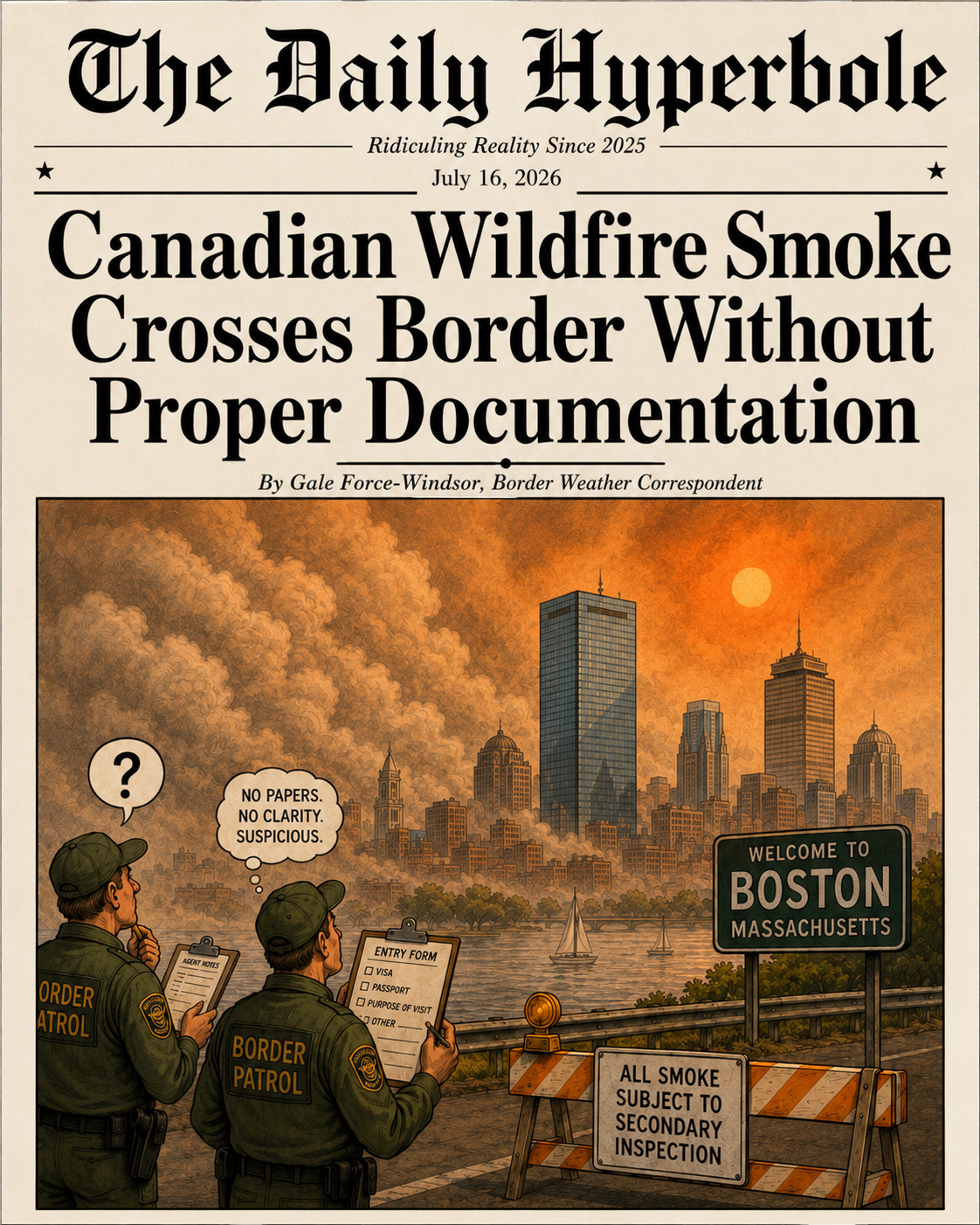
The smoke, believed to have originated somewhere in the burning forests of central Canada, reportedly drifted south across the international boundary early Wednesday morning before dispersing throughout several American states and refusing repeated requests to identify itself.
“This is a clear violation of our sovereign airspace,” said acting Customs and Border Protection spokesperson Darren Flagg, gesturing upward at several thousand square miles of orange-gray haze. “Every foreign substance entering this country must present valid documentation. This smoke presented nothing. No passport. No itinerary. No proof of lodging. It just floated in like it owned the place.”
Authorities first became suspicious when residents across the Northeast noticed the sun had been replaced by a dim orange coin and the atmosphere smelled like a campfire operating under deeply unsafe conditions.
Border Patrol agents were immediately dispatched to intercept the smoke but reported difficulty determining where, exactly, to place the handcuffs.
“We surrounded it,” said one agent stationed near Niagara Falls. “But then we realized it was also behind us, above us, inside the vehicle, and apparently in our lungs. That complicated the arrest.”
Officials say the smoke ignored several verbal commands to stop drifting and continued moving south at approximately 20 miles per hour.
At one point, agents deployed a large industrial fan in an attempt to push the smoke back toward Canada. The operation was abandoned after the fan overheated, caught fire, and generated additional smoke of uncertain nationality.
The Department of Homeland Security has since classified the cloud as an “unauthorized atmospheric entrant” and warned Americans not to offer it shelter, employment, or access to indoor ventilation systems.
“If you see suspicious smoke in your neighborhood, do not approach it,” Flagg said. “Close your windows, remain indoors, and report any unexplained haze to the appropriate federal authorities. Do not attempt to inhale the suspect.”
Canadian Prime Minister Mark Carney issued a formal apology Thursday afternoon, describing the incident as “deeply regrettable” and promising that Canada would “politely ask the smoke to come home.”
“We are extremely sorry that our smoke entered the United States without permission,” Carney said. “This does not reflect Canadian values. Canadian smoke is normally respectful, orderly, and willing to wait quietly in line.”
The apology was followed by a second, denser wave of smoke moving south across the Great Lakes.
Canadian officials stressed that the additional smoke was not an act of aggression but merely part of the apology process.
President Trump responded by announcing an immediate 25 percent tariff on all Canadian smoke, ash, soot, embers, haze, fog, and “other suspicious sky products.”
“For years, Canada has been flooding our country with smoke,” Trump said during a press conference held indoors beneath several air purifiers. “Nobody has ever seen smoke like this. Very unfair smoke. Extremely Canadian smoke. We’re going to charge them for every particle.”
Economists were unable to explain how the tariff would be collected.
The administration later clarified that Customs agents would estimate the total volume of smoke using “advanced visual assessment,” then mail an invoice to Ottawa.
“This smoke has taken American visibility,” Trump continued. “It has taken American sunlight. It may even be taking American oxygen. We are looking into it very strongly.”
Environmental experts attempted to remind federal officials that smoke moves through the atmosphere according to wind patterns rather than immigration law, but their briefing was reportedly cut short after one official asked whether the jet stream could be deported.
“We cannot solve this with checkpoints,” said Dr. Laura Mendez, an atmospheric scientist. “The smoke is being carried by large-scale weather systems.”
“Exactly,” replied Homeland Security Secretary Markwayne Mullin. “Large-scale trafficking systems.”
The smoke has already been linked to deteriorating air quality, reduced visibility, canceled outdoor events, and a sharp increase in Americans standing outside for several seconds before saying, “Oh, wow, yeah, that’s bad,” and returning indoors.
In New York City, residents were advised to avoid strenuous outdoor activity, especially jogging, biking, breathing deeply, or attempting to remember what the sky normally looks like.
Boston officials issued similar guidance, asking residents to conserve clean air by limiting respiration to essential activities.
“We recommend short, efficient breaths,” said one city health official. “No recreational breathing. No dramatic sighing. Please postpone all gasping until conditions improve.”
Meanwhile, several governors have requested federal assistance, including air filters, emergency masks, and a very large dome.
At the northern border, agents continued efforts to locate the smoke’s point of entry.
“We believe it may have crossed somewhere between Washington state and Maine,” said Flagg. “We’re narrowing it down.”
By Thursday evening, federal authorities announced that the smoke would be permitted to remain temporarily while its asylum claim was reviewed.
According to preliminary paperwork, the smoke claims it fled Canada due to fire.
The Daily Hyperbole has learned that immigration officials consider the claim credible but remain concerned that the smoke may become a public charge.
At press time, the cloud had secured temporary employment making sunsets look apocalyptic.