
Company Clarifies Employees May Only Be Enslaved During Business Hours
JPMorgan reiterates commitment to work-life balance amid confusing lawsuit allegations
NEW YORK, NY — In an effort to restore order following a deeply confusing lawsuit involving allegations of coercion, corporate overreach, and unclear job descriptions, JPMorgan Chase issued a formal clarification Friday confirming that any alleged employee enslavement must occur strictly within designated business hours.
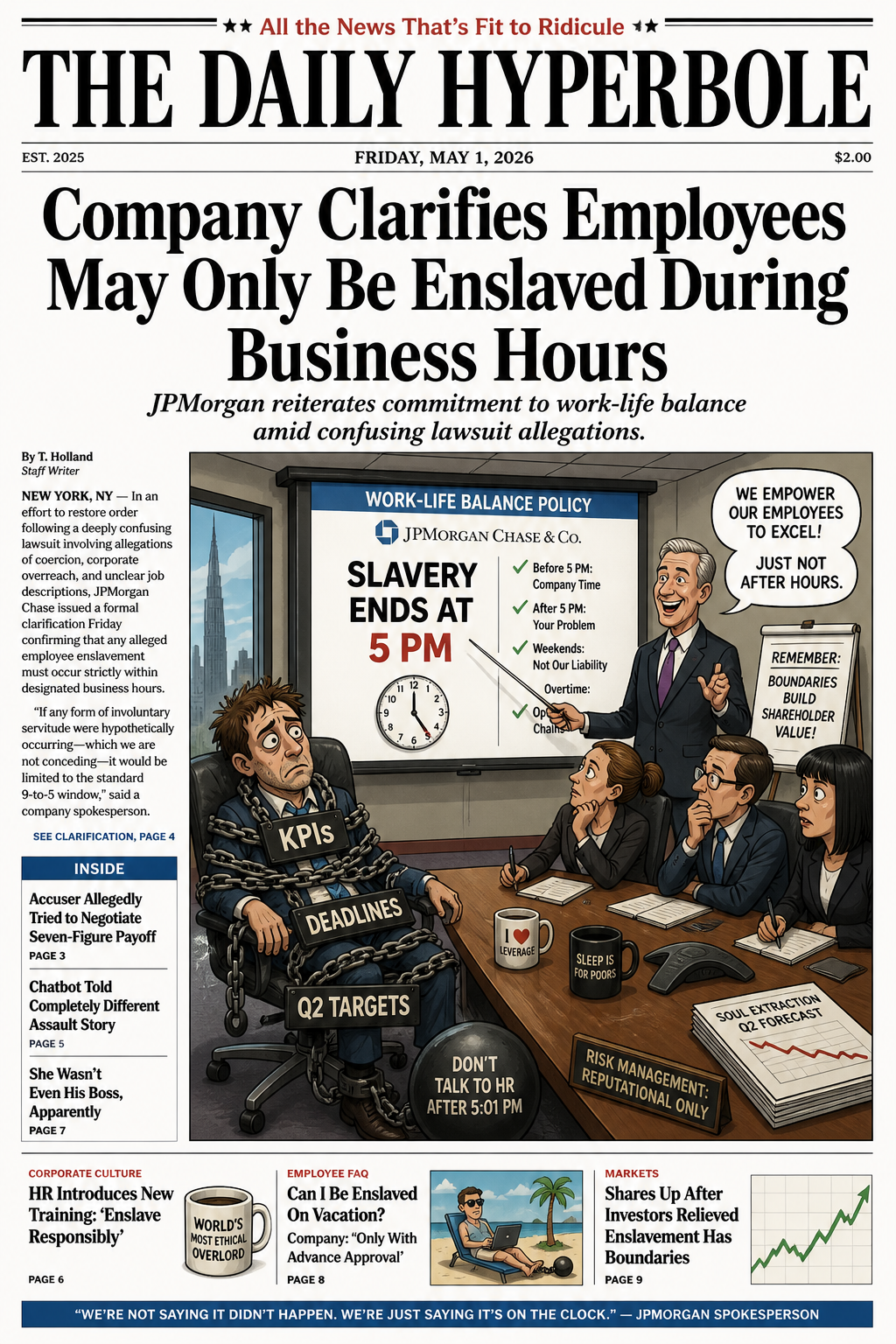
“We want to be absolutely clear,” said a company spokesperson during a hastily organized press briefing. “If any form of involuntary servitude were hypothetically occurring—which we are not conceding—it would be limited to the standard 9-to-5 window, with a firm cutoff at 5:01 p.m. Eastern.”
The statement comes after a former employee filed—and quickly withdrew—a lawsuit describing an alleged workplace dynamic that experts say “raised more questions than it answered, then answered none of them.”
“Boundaries Matter,” HR Confirms
According to internal sources, the company’s Human Resources department moved swiftly to reassure employees that strict policies remain in place governing all forms of workplace conduct, including those not previously considered.
“Employees are encouraged to report any instances of after-hours enslavement immediately,” read an internal memo. “We take violations of work-life balance extremely seriously.”
The memo also included a new FAQ section addressing common concerns:
Q: Can I be enslaved on weekends?
A: Only if pre-approved through Workday.Q: What if I’m unsure whether I’m being enslaved?
A: Please consult your manager or a trusted colleague.Q: Does this affect my PTO?
A: PTO requests must still be submitted two weeks in advance.
Managers Urged to “Lead Responsibly”
Executives across the firm were reportedly instructed to review their leadership styles and ensure that any perceived dominance in the workplace remains “strictly metaphorical and performance-based.”
“We empower our leaders to inspire—not to enslave,” said one senior executive, pausing briefly. “Unless, of course, you count quarterly targets.”
Employees Seek Clarity, Receive None
Despite the company’s reassurances, many employees admitted they remain uncertain about where exactly the line is drawn.
“I just want to know if this counts as normal burnout or something more formal,” said one analyst, staring blankly at a spreadsheet labeled “Q2 Soul Extraction Forecast.”
Others expressed relief at the clarification.
“Honestly, as long as it stops at 5, I can live with it,” said another employee. “That’s when I go home and experience my personal form of existential dread.”
Legal Experts Weigh In
Legal analysts say the situation highlights a growing challenge in modern corporate America: distinguishing between actual misconduct and what one expert described as “the general vibe of working in finance.”
“At this point, we’re not even sure what the claim is,” said one attorney. “But we are sure it somehow involves PowerPoint.”
Company Remains Confident
As of press time, JPMorgan Chase reiterated its commitment to maintaining a safe, respectful, and ambiguously defined workplace.
“We will continue to investigate this matter thoroughly,” the spokesperson concluded. “Or at least until everyone forgets what it was about.”