
Local Man Invents Telepathy, Still Insists on PowerPoint
By Thurston P. Bootstrap IV | The Daily Hyperbole | October 16, 2026
COLUMBUS, OHIO — Despite secretly developing a technology capable of transmitting complex ideas directly between human minds, local IT specialist Brian Haskett maintained Friday that humanity’s best hope remained a well-organized PowerPoint presentation.
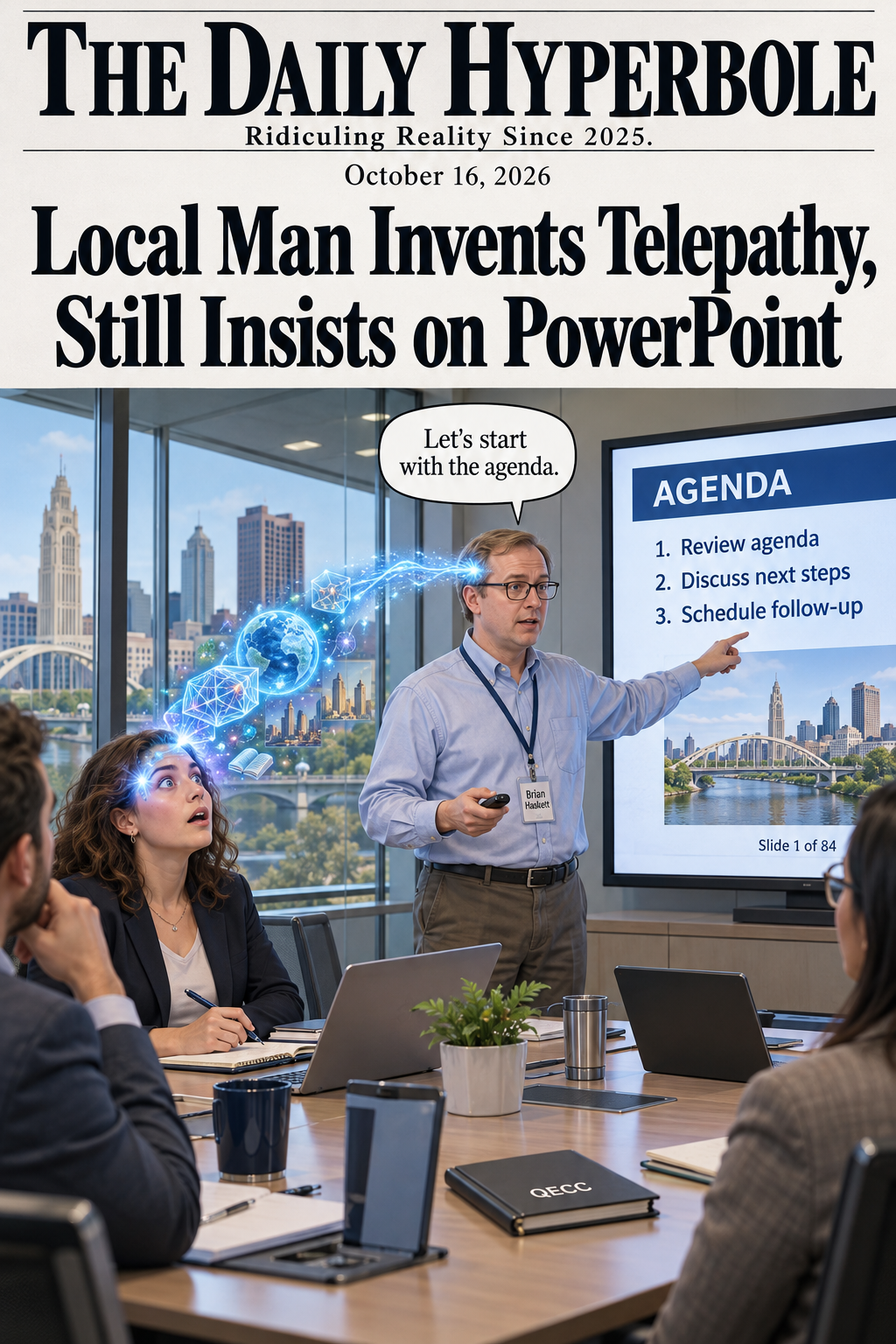
“I’m excited about the possibilities,” said Haskett, 41, pausing his research to help a consultant make three boxes the same size. “Think what this could do for decks.”
Haskett works in internal IT at Bramble & Keene, a management consulting firm where he helps employees turn business insights into presentations and occasionally turn presentations back into files that will open.
Most of his colleagues know him only as the man who fixes the conference-room display. They have no idea that he has eliminated the need for displays, conference rooms, or, in most circumstances, speaking.
Developed after hours in his basement, his hidden invention, Quantum Entangled Consciousness Communication, or QECC, allows people to transmit thoughts, memories, and complete concepts directly from one mind to another, regardless of physical distance.
Haskett keeps the research in a folder labeled “Legacy Printer Documentation.” It has never been accessed by another employee.
Only one coworker, project manager Melissa Crane, has participated in a demonstration. During the test, Haskett transmitted an entire proposed business strategy into her consciousness in a fraction of a second. Crane instantly understood its objectives, financial assumptions, implementation requirements, and every potential obstacle.
“There was no confusion,” Crane recalled. “For the first time in my professional life, I understood exactly what someone meant.”
She then asked whether he could put it in the company template.
Haskett considered this excellent feedback.
“People hear ‘telepathy’ and immediately assume we can skip the deck,” he said. “But an idea entering your consciousness isn’t the same as a deliverable entering the shared drive.”
According to Haskett, direct mental communication suffers from several limitations that PowerPoint resolved years ago. Thoughts lack page numbers. Memories rarely include a copyright footer. An overwhelming sense of shared human understanding cannot easily be marked “Draft — For Discussion.”
Most concerning, QECC allows recipients to comprehend an entire subject at once, before anyone has had an opportunity to walk them through the agenda.
“That’s a lot to spring on a client,” he said.
Haskett has declined to commercialize the invention, explaining that the firm is entering its fourth-quarter planning cycle and cannot afford to lose the only person who understands why the logo disappears when someone changes the slide layout.
His loyalty, however, extends beyond professional obligation. He sincerely believes PowerPoint gives ideas something telepathy never could: a rectangular place to become official.
“You could have a profound realization about the future of this company,” he explained. “But until someone puts it next to a stock photo of a suspension bridge, how do we know it’s a strategy?”
Crane has suggested that QECC could eliminate misunderstanding, accelerate education, and compress weeks of consulting work into seconds.
Haskett acknowledged these benefits but urged caution.
“If the client understands everything immediately, what are we presenting on Thursday?”
He has begun developing a version of QECC that transmits one thought at a time, with a brief pause while the recipient waits for him to locate the next thought. A premium version will allow him to return to an earlier thought because someone has a question about the numbers.
His ultimate ambition is to connect every human consciousness on Earth to a single, universal presentation template.
“Imagine eight billion people sharing knowledge freely,” he said. “All using the correct shade of blue.”
At press time, Haskett had received an urgent request from a partner who needed a photograph to appear only after clicking.
Although he could have transmitted the solution instantly, Haskett opened PowerPoint and began preparing a seven-slide guide.
The instructions began on slide five.