
Employee Returns From Time Off Unsure Why Job Exists
By Staff Writer, Still Mentally On PTO
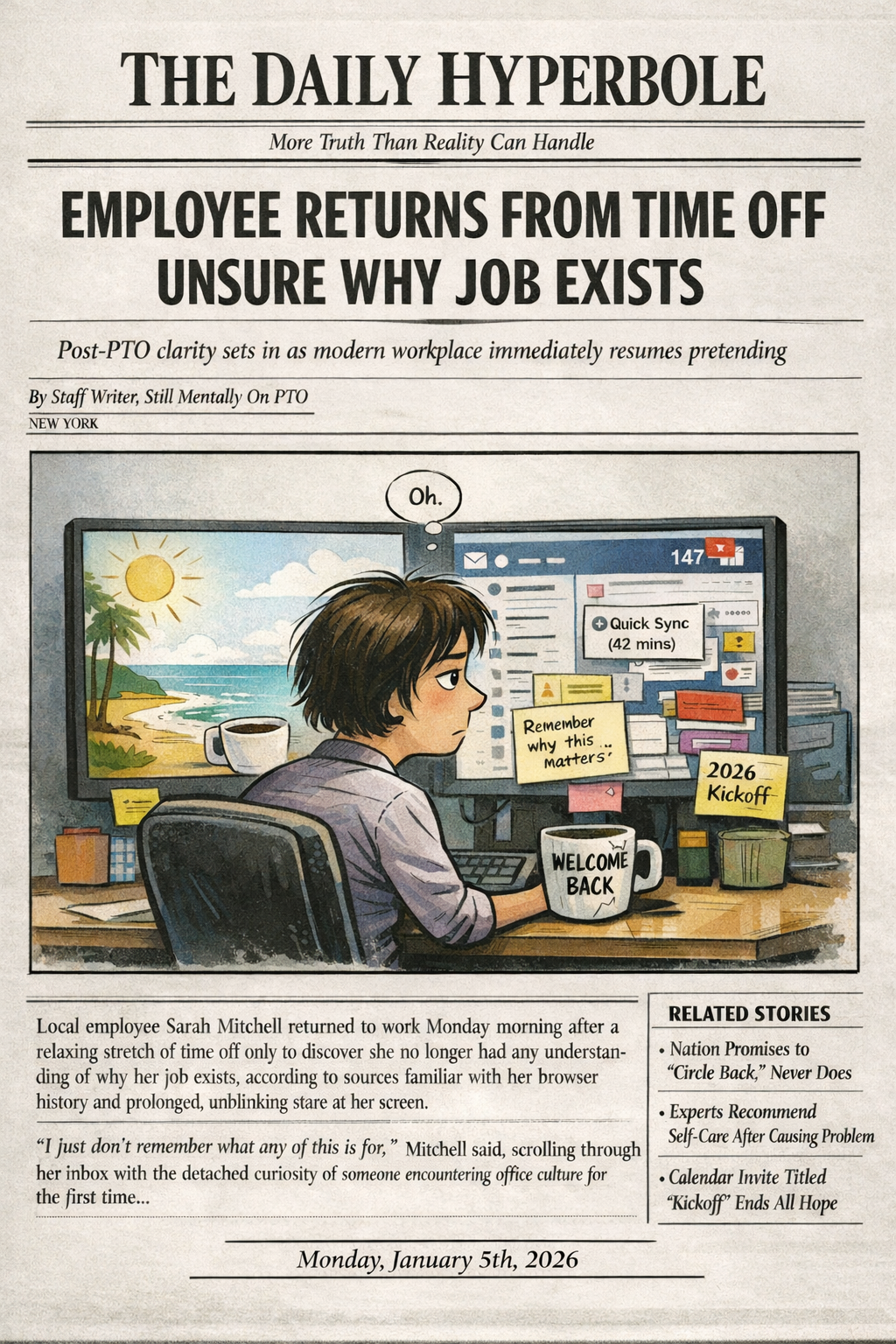
NEW YORK — Local employee Sarah Mitchell returned to work Monday morning after a relaxing stretch of time off only to discover she no longer had any understanding of why her job exists, according to sources familiar with her browser history and prolonged, unblinking stare at her screen.
Mitchell, who spent the first 17 minutes of her day reopening applications she had responsibly closed before her break, reportedly logged on feeling refreshed, well-rested, and dangerously clear-headed—an emotional state experts warn makes the modern workplace feel immediately fraudulent.
“I just don’t remember what any of this is for,” Mitchell said, scrolling through her inbox with the detached curiosity of someone encountering office culture for the first time. “I know I used to care about these emails. I have proof. But right now I’m not convinced any of this needs to happen.”
Sources confirm Mitchell’s inbox greeted her warmly with several variations of “Hope you had a great break!” before immediately demanding action on items that were neither urgent before the break nor meaningfully different now.
“She was really shaken by how nothing changed,” said one coworker, who asked to remain anonymous out of respect for the group chat. “It’s like time paused for two weeks and then restarted exactly where it left off, which felt personal.”
Within minutes of returning, Mitchell reportedly attended a “quick sync” that lasted 42 minutes and ended with no decisions, no follow-up plan, and a vague agreement to “circle back later this week.” Observers say this was the moment she muted her microphone and quietly whispered, “Why do we do this?”
According to internal data, Mitchell spent much of the morning toggling between work documents and vacation photos, attempting to reconcile the version of herself who once drank coffee slowly and felt sunlight with the version now being asked to “drive alignment” by EOD.
“I forgot how many jobs are just emails about other emails,” Mitchell said. “At one point I was replying to a message summarizing a meeting that could have been another message. I genuinely felt lightheaded.”
Experts say this phenomenon—known as Post-PTO Clarity—is common among workers who experience even brief exposure to autonomy, rest, or weekday joy.
“When people step away from work long enough to remember their personalities, returning can be destabilizing,” said workplace psychologist Dana Feldman. “They start asking dangerous questions like ‘Does this matter?’ or ‘Why is this due today?’ instead of healthier ones like ‘How late will I stay?’”
By mid-afternoon, Mitchell reportedly attempted to ease back in by making a to-do list, only to realize every task fell into one of three categories: something she didn’t remember agreeing to, something that existed before the break without consequence, or something labeled “high priority” with no clear outcome.
“She kept opening Slack like it might explain itself,” Feldman added.
At press time, Mitchell was said to be fully reintegrated into work life after receiving a calendar invite titled “2026 Kickoff,” which immediately extinguished the last remaining trace of vacation energy.
“Once I accepted that I will simply continue doing this indefinitely, it got easier,” Mitchell confirmed. “I’m already planning my next break so I can forget again.”