
Local Couple Achieves American Dream by Inheriting It
Hard Work Supplemented by Generational Wealth, Just Like Founding Fathers Intended
By Thurston P. Bootstrap IV
Intergenerational Wealth Correspondent
Location: A Tastefully Renovated Brownstone (Purchased With Help)
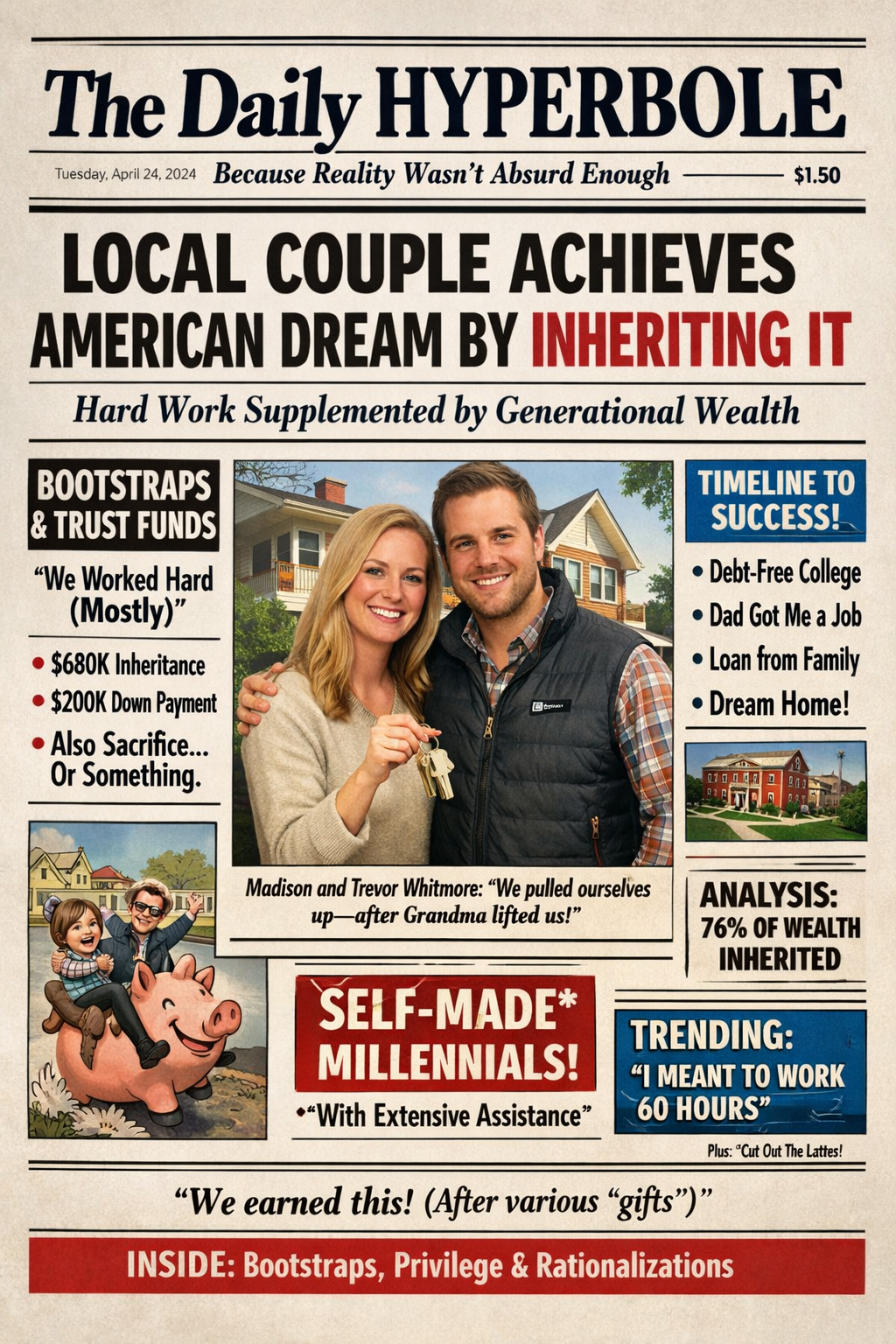
CAMBRIDGE, MASSACHUSETTS — Local couple Madison and Trevor Whitmore, both 32, announced this week that they have successfully achieved the American Dream through a combination of hard work, determination, and receiving a $680,000 inheritance from Trevor’s grandmother.
“We worked really hard for this,” Madison explained from the couple’s newly purchased four-bedroom colonial, which they acquired after a modest $200,000 down payment funded entirely by family wealth accumulated over three generations.
“Trevor worked 60-hour weeks for almost two years,” she added. “Well, 50 hours. Sometimes 45. But the intent to work 60 hours was always there.”
The Bootstraps Method (With Assistance)
The couple credits their success to classic American values:
Perseverance (accepting the inheritance without hesitation)
Sacrifice (delaying the kitchen renovation by three months)
Fiscal responsibility (investing family money wisely)
Strategic planning (being born into the right family)
“People always ask us, ‘How did you do it?’” Trevor said, adjusting his Patagonia vest.
“And I tell them: you just have to want it badly enough. Also, generational wealth. But mostly wanting it.”
A Timeline of Achievement
Age 22: Graduated debt-free after parents paid tuition
Age 24: Landed first job through father’s college roommate
Age 26: Saved down payment (grandma’s estate settled)
Age 28: Bought first home with family loan at 0% interest
Age 32: Upgraded to dream home using home equity that was technically always family money
“We pulled ourselves up by our bootstraps,” Trevor explained.
“Granted, the bootstraps were Ferragamo and pre-purchased, but we did pull.”
Overcoming Adversity
The couple faced numerous challenges on their journey:
Deciding which inheritance vehicle to use (trust fund vs. direct transfer)
Waiting six months for probate to clear
Choosing between the colonial and a slightly larger Victorian
Managing guilt about not struggling like their peers
“There were times we almost gave up,” Madison admitted.
“Like when we couldn’t decide on marble countertops. But we persevered. That’s what separates people like us from… well, people not like us.”
Advice for Others
When asked what advice they’d give to struggling millennials, the couple offered wisdom:
Trevor: “Just save more. We put away 40% of our income.”
Reporter’s note: Their income was supplemented by a $4,000/month family trust they forgot to mention.
Madison: “Cut out the lattes. We make coffee at home.”
Reporter’s note: Their espresso machine cost $3,200.
Trevor: “Live below your means.”
Reporter’s note: Their ‘means’ include regular infusions of family capital they don’t categorize as income.
Madison: “Anyone can do this. You just have to be smart with money.”
Reporter’s note: Their financial advisor is paid by the family trust.
The Self-Made Myth
Economic analysts note that the Whitmores represent a growing demographic:
the “self-made-adjacent.”
“They’re not technically self-made,” explained Dr. Helena Reyes, economist at the Institute for Uncomfortable Truths.
“But they’ve worked hard at not acknowledging the structural advantages, which takes considerable psychological effort.”
According to Dr. Reyes, 76% of wealth in America is inherited or derived from family advantages like:
Debt-free education
Interest-free family loans
Down payment “gifts”
Professional networks
The confidence that comes from never fearing homelessness
“The Whitmores are normal,” Dr. Reyes said.
“What’s abnormal is pretending the inheritance wasn’t the determining factor.”
Pushback Against ‘Haters’
When confronted with statistics about wealth inequality, Trevor became defensive.
“People are just jealous,” he said. “My grandmother worked for that money.”
His grandmother inherited it from her father, a railroad baron.
“We earned this,” Madison insisted.
“Sure, we had help. But everyone has help. Like… friends give you advice. That’s basically the same thing.”
When pressed on whether free college, zero debt, and a $680,000 inheritance might constitute more than “advice,” Madison clarified:
“Obviously it helped. But we still had to, like, accept the money and decide how to use it. That’s entrepreneurship.”
The Cognitive Dissonance
Sociologists note that the Whitmores exist in a state of
“meritocratic contradiction”—simultaneously believing they earned their success while depending entirely on unearned advantages.
“It’s a fascinating psychological defense mechanism,” said Dr. Aaron Kim, sociologist at Harvard.
“They need to believe in meritocracy to feel good about their position, but they can’t acknowledge the role of inheritance without dismantling that belief. So they do both, somehow.”
When asked directly whether they could have achieved the same success without family wealth, Trevor paused for 11 seconds before saying:
“Hypothetically? Sure. I mean, probably. It would’ve taken longer. Like, 40 or 50 years longer. But theoretically possible.”
Madison added:
“The point is, we could have. We just didn’t have to. And that’s the beauty of America.”
Future Plans
The couple plans to pass their wealth to their future children, continuing the cycle.
“We want to teach them the value of hard work,” Madison said.
“By giving them everything so they never have to experience actual hardship. That’s how you build character.”
At press time, the Whitmores were featured in a local magazine article titled
“Young Couple Beats the Odds,” which carefully avoided mentioning the inheritance.
Trevor is now writing a self-help book titled:
Bootstraps & Trust Funds: How I Made It (With Help I Don’t Talk About).
Pre-orders are available on a website hosted on servers paid for by the family estate.
EDITOR’S NOTE
The Whitmores requested we mention they “support progressive taxation” and “acknowledge their privilege,” which they demonstrate by occasionally feeling vaguely uncomfortable at dinner parties.
ABOUT THE AUTHOR
Thurston P. Bootstrap IV is the great-great-grandson of Cornelius Bootstrap, robber baron.
He writes about wealth inequality from his summer home (inherited).
His hobbies include downplaying advantages and attributing success to “grit.”