
Local Millennial Discovers They Can’t Afford Therapy to Process Why They Can’t Afford Anything
Irony Not Lost on Generation, Just Financially Inaccessible
By Dr. Regina Downward-Spiral
Economic Despair Correspondent
Location: A Studio Apartment Worth $2,400/Month (Utilities Not Included)
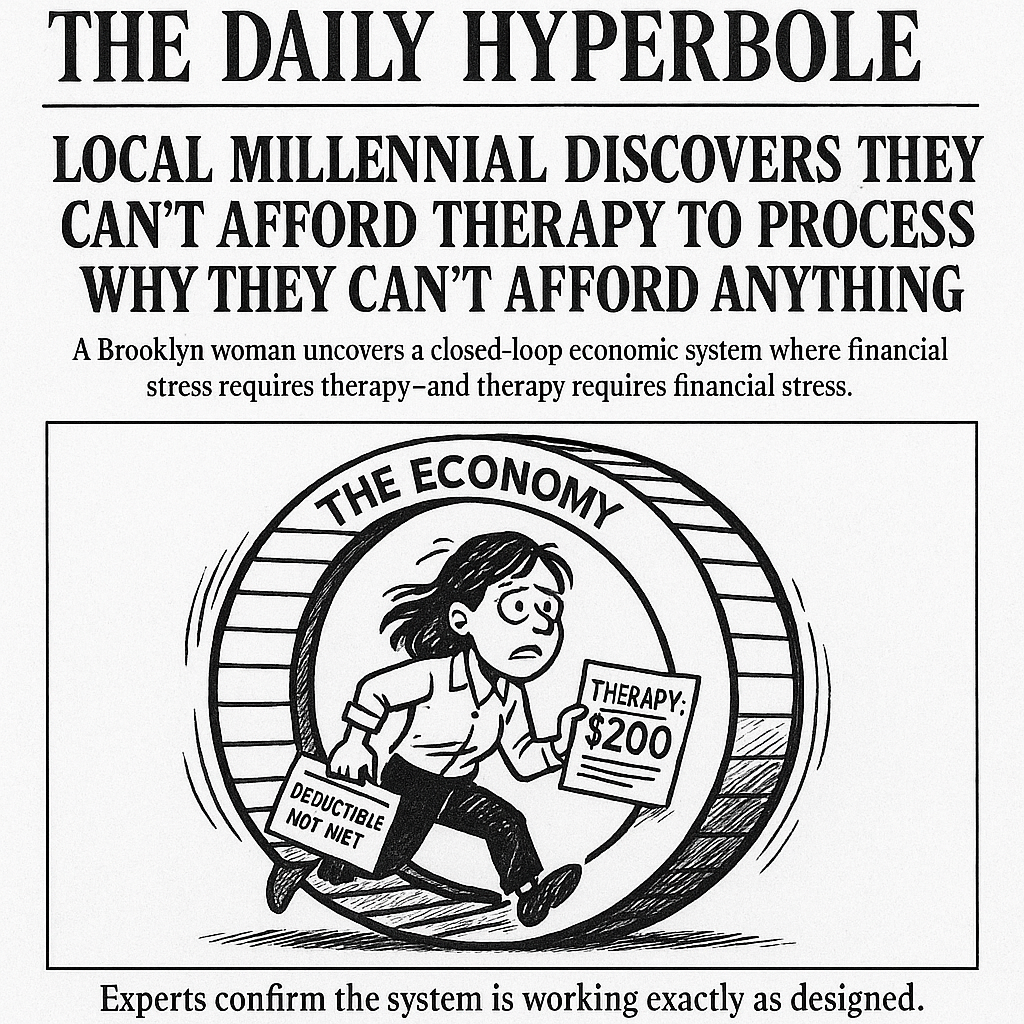
BROOKLYN, NEW YORK —Local millennial Ashley Chen, 34, experienced a major personal breakthrough this week when she realized she cannot afford the therapy sessions required to process the crushing anxiety caused by not being able to afford anything.
“It hit me while I was looking at my budget spreadsheet,” Chen explained, gesturing to a color-coded Excel document titled Why Am I Like This (Financial Edition). “I need therapy to deal with my financial stress. But therapy costs money. Which causes more financial stress. Which requires more therapy.”
Chen paused, staring into the middle distance.
“I think I just invented a perpetual motion machine,” she said,
“but for sadness.”
The Ouroboros of Economic Anxiety
Mental health professionals confirmed that Chen’s predicament represents what experts are calling Recursive Economic Despair Syndrome (REDS)—a condition in which the cost of treating financial anxiety exceeds the financial resources of the person experiencing it.
“It’s a perfect closed loop,” explained Dr. Harold Keynes, health economist at the Institute for Things That Shouldn’t Be This Complicated.
“You’re stressed about money, so you need therapy. Therapy costs money you don’t have, which causes more stress, which requires more therapy. It’s beautiful—
in a soul-crushing kind of way.”
According to Dr. Keynes:
Average therapy session: $200 without insurance
With insurance: $40 per session
After meeting a $7,000 deductible that conveniently resets every year
“Basically,” he said, “you need to have a mental breakdown expensive enough to justify the cost.”
A Budget Built on Hope and Delusion
Chen’s monthly budget reveals the impossible mathematics facing her generation:
INCOME
Salary (after taxes, student loans, and existential dread): $2,800
EXPENSES
Rent (400 sq ft of ‘luxury’ living): $2,400
Groceries (rice-based survival mode): $200
Health insurance (covers nothing until catastrophe): $350
Therapy (to process all of the above): $800
Student loans (for a degree that promised stability): $450
TOTAL REQUIRED: $4,200
“See?” Chen said, pointing at the spreadsheet with increasing agitation.
“I’m $1,400 short every month before I even start dealing with my unresolved childhood trauma and fear of economic collapse.”
When asked how she currently manages her mental health, Chen laughed—a sound that contained decades of broken bootstrap metaphors.
“I just scream into a pillow sometimes,” she said.
“And watch TikToks about financial literacy that somehow make me feel worse.”
The Self-Help Industrial Complex Weighs In
Wellness influencers were quick to offer solutions.
“Have you tried journaling?” suggested lifestyle guru Madison Moonbeam, speaking from her parent-funded wellness retreat in Tulum.
“It’s free. You can write down your feelings instead of burdening a trained professional.”
When informed that Chen’s feelings include rage at people who suggest journaling, Moonbeam recommended:
“Manifesting abundance”
“Realigning chakras with the frequency of financial prosperity”
Cost of chakra realignment: $300 per session.
Insurance Companies Respond with a Generous Offer
In a statement released this morning, Chen’s insurance provider confirmed they would happily cover her therapy sessions—after she meets her $7,000 annual deductible.
“We’re committed to mental health,” said spokesperson Richard Loophole III.
“Which is why we encourage Ms. Chen to experience a mental health crisis significant enough to require hospitalization. Once she hits her deductible through an emergency psychiatric hold, outpatient therapy will only cost $40 per session.”
He added, “We’re here to help. Financially, though, you’re on your own.”
The Breaking Point
At press time, Chen was researching “free therapy alternatives,” leading her to:
YouTube videos titled Heal Your Inner Child in 10 Minutes (No Therapist Required)
Reddit threads staffed by strangers with confidence but no credentials
An app advertising AI-Powered CBT for $29.99/month (billed annually, non-refundable)
Her mother’s advice to “just think positive thoughts”
“I guess I’ll just… work on myself?” Chen said, her voice trailing into the void where disposable income once lived.
“Or I could get a second job to afford therapy. But then I’d need therapy to process working two jobs. But I wouldn’t be able to afford that therapy because—”
She stopped mid-sentence, realizing she had discovered another loop.
Economists are now studying whether Chen’s condition represents a breakthrough in perpetual economic motion—a system capable of generating infinite anxiety without any external input.
EDITOR’S NOTE
If you or someone you know is experiencing Recursive Economic Despair Syndrome, experts recommend taking deep breaths—
which are still free in most states.
ABOUT THE AUTHOR
Dr. Regina Downward-Spiral holds a Ph.D. in Millennial Economic Futility from the University of Unfulfilled Potential. She specializes in chronicling the slow collapse of generational hope. Her hobbies include checking her bank account and crying.