
Company unveils executive security patch after discovering leather jacket is not a firewall.
By Thurston P. Bootstrap IV
The Daily Hyperbole | November 9, 2026
SANTA CLARA, CA — Nvidia, whose chips power some of the most sophisticated artificial intelligence systems on Earth, announced Monday that its next major engineering challenge would be preventing a man in a leather jacket from clicking “Allow” on a conversation.
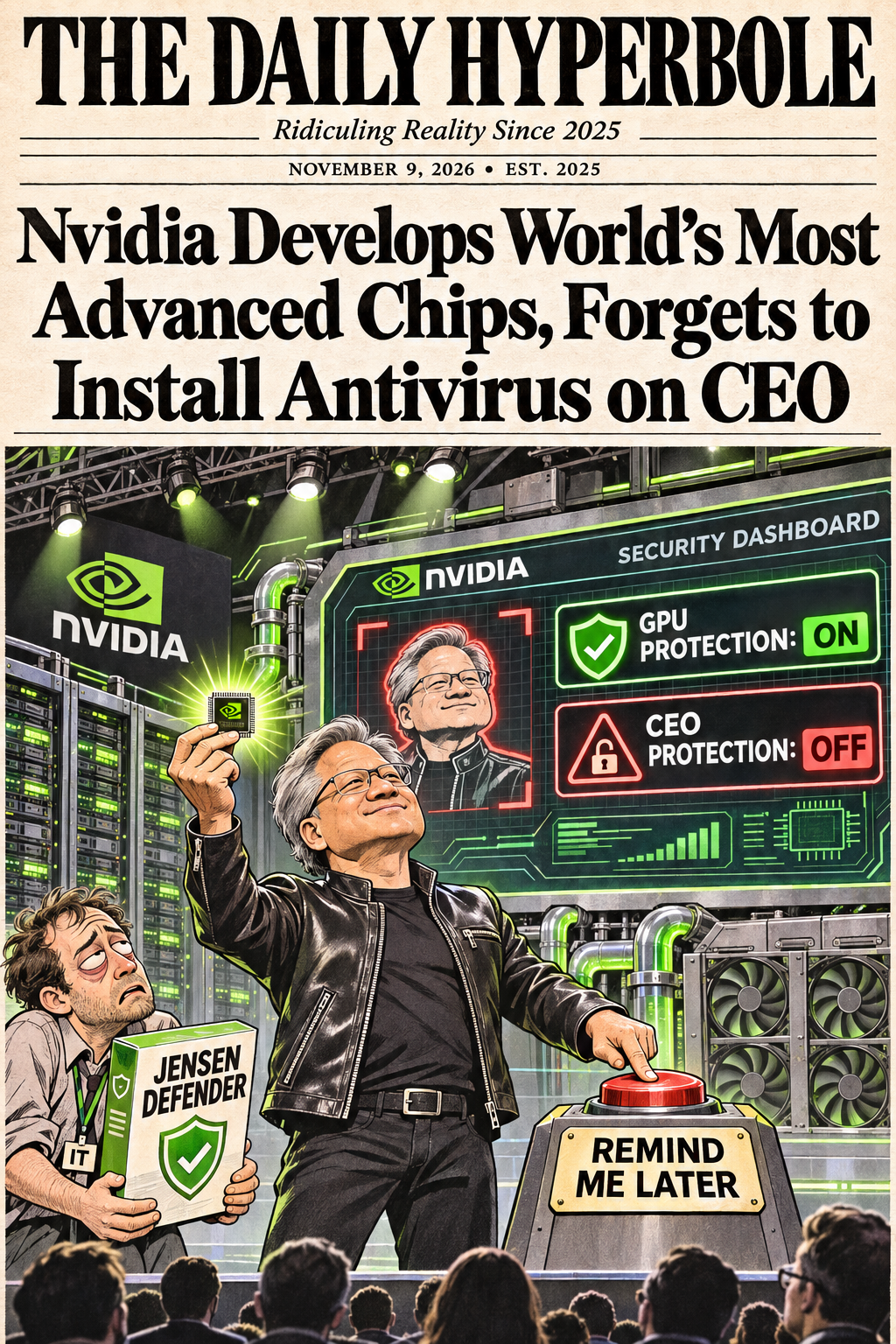
“We secured the servers. We encrypted the files. We restricted access to the buildings,” said fictional chief security officer Martin Patch. “Then we remembered the CEO can leave.”
The company’s board really did announce an independent investigation on November 8 into reports that Jensen Huang was targeted by a foreign intelligence effort. Nvidia says it has no reason to believe national security or company secrets were compromised.
Nevertheless, the inquiry has raised difficult questions about whether Silicon Valley’s plans to replace human judgment with artificial intelligence should begin slightly higher up the organizational chart.
“For years, the industry has warned that receptionists, accountants, and junior programmers are dangerously inefficient,” said technology analyst Deborah Cache. “Apparently the person who most urgently needs an AI assistant is the one giving that presentation.”
In response, Nvidia unveiled Jensen Defender, an executive antivirus suite designed to detect suspicious attachments, including emotional ones.
The software monitors incoming praise and flags phrases such as “You’re the only person who understands this,” “Your board is holding you back,” and “Perhaps you could explain the entire semiconductor supply chain over dinner.”
Any compliment containing more than three references to the word “visionary” is automatically forwarded to Legal.
“We initially trained it on ordinary phishing emails,” Patch explained. “Unfortunately, CEOs don’t respond to messages telling them they’ve won a million dollars. We had to change it to ‘You alone can save civilization.’”
The first demonstration was interrupted when the system quarantined an entire technology conference.
Engineers said the most difficult feature to implement was two-factor authentication, which now requires an executive to clear any sensitive disclosure with a second person who has not just been told they are a genius.
Previously, company policy had treated a CEO’s confidence as two independent forms of identification.
The updated software also includes a mandatory thirty-second delay between experiencing flattery and developing a new position on international trade.
“Thirty seconds doesn’t sound like much,” said Cache. “But in executive decision-making, that’s practically peer review.”
Industry leaders have welcomed the development, although several have requested an enterprise version that protects against podcasts, flattering magazine covers, and people who say, “The regulators are simply afraid of your brilliance.”
One unnamed founder immediately asked whether the software could be configured to block criticism while allowing compliments through.
“That’s the configuration we’re trying to fix,” Patch said.
Nvidia’s engineers also attempted to install a firewall directly into Huang’s signature leather jacket, but abandoned the project after discovering it contained too many ports for speaking engagements.
A proposed “least privilege” setting encountered similar difficulties.
“The idea is that each person should have access only to what they need,” Patch explained. “The board loved it until we got to the person who runs the company.”
Investors were reassured that executive security would soon become a recurring revenue opportunity. Jensen Defender will cost $49.99 per month, with common sense available through a separate enterprise agreement.
The free version detects a potential conflict of interest, announces that a potential conflict of interest has been detected, and then requires the user to upgrade to find out why that might matter.
Asked whether Nvidia intended to use its own advanced AI to evaluate executive decisions, the company said the system was almost ready.
It had already passed graduate-level examinations, identified complex software vulnerabilities, and modeled thousands of hypothetical security scenarios.
Its final test was a CAPTCHA.
Select all squares containing a conflict of interest.
At press time, the board had hired an independent committee to click them.