
Congress Vows To Tackle Corruption Right After Massive Fundraiser With Defense Contractors
Lawmakers say real reform is finally possible now that everyone has been properly thanked for their generosity.
WASHINGTON, D.C.
By Thurston P. Bootstrap IV, Senior Procurement Ethics Correspondent
In a stirring bipartisan display of principle, members of Congress pledged Tuesday to crack down on corruption immediately following an elegant private fundraiser attended by several of the nation’s largest defense contractors, lobbyists, consultants, and “concerned stakeholders” with active financial interests in never-ending war.
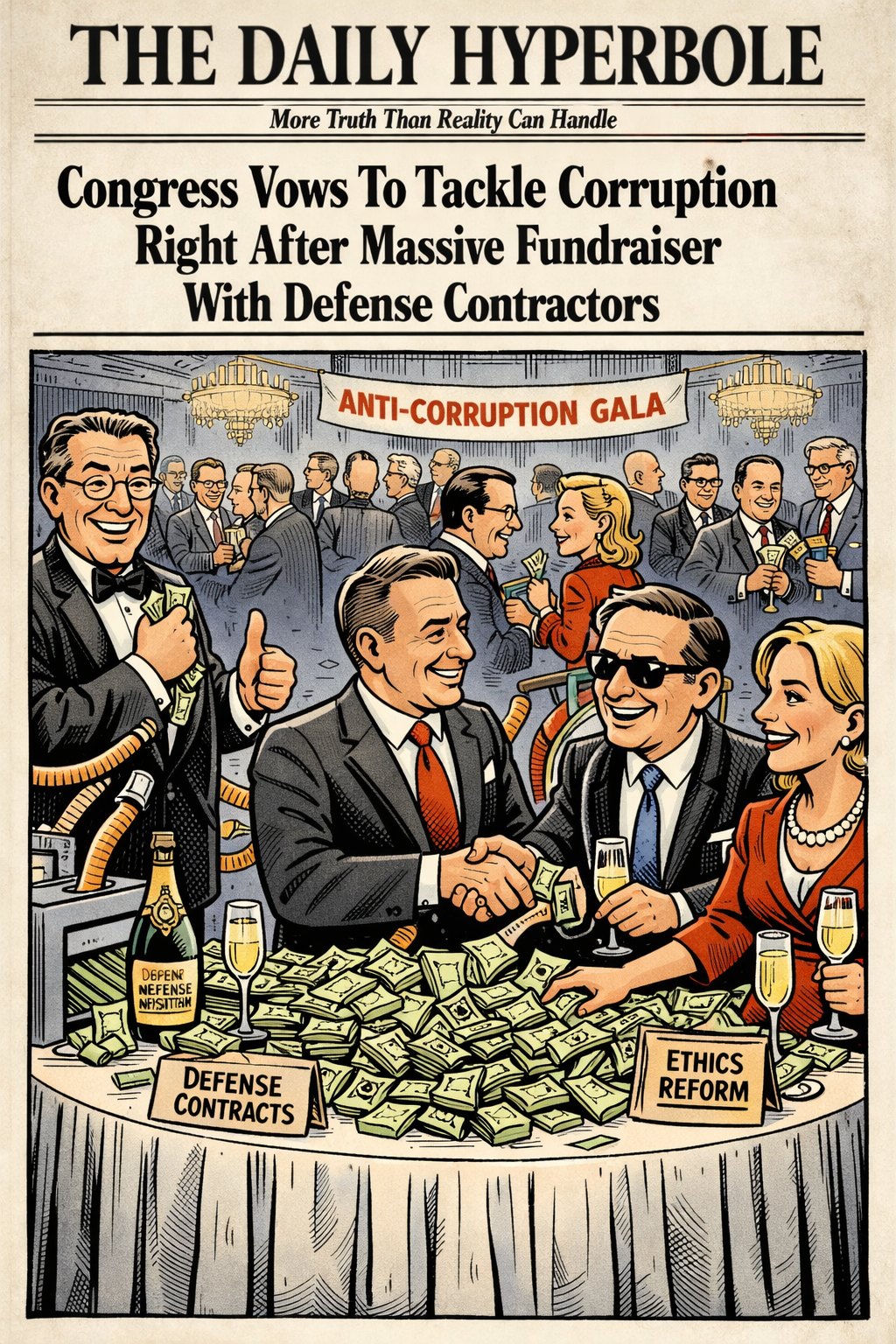
Standing beneath a banner reading RESTORING PUBLIC TRUST 2026, lawmakers assured the American people that corruption in Washington remains a top priority, especially the kind practiced by other people, lower-level staffers, and whichever party is not currently speaking.
“We want to be crystal clear,” said one senior lawmaker while accepting a commemorative crystal eagle from a weapons manufacturer. “The American people are sick and tired of backroom deals, insider influence, and the perception that public policy is being shaped by wealthy special interests. That is why tonight, in this room full of patriotic donors, we are drawing a line in the sand.”
The remarks were met with thunderous applause from guests who had each paid between $5,000 and $50,000 per plate for the opportunity to hear elected officials denounce the corrupting influence of money in politics.
Attendees described the evening as a powerful call to action. Along with cocktails, hors d’oeuvres, and a brief multimedia presentation on “defending democracy abroad,” the event featured intimate breakout sessions where lawmakers discussed ethics reform, transparency, and the urgent need for increased discretionary spending.
According to insiders, the fundraiser raised millions for candidates committed to accountability, oversight, and ensuring that no serious investigation ever becomes disruptive enough to affect procurement timelines.
“We cannot allow powerful institutions to operate without scrutiny,” said another member of Congress, shortly before slipping into a side room for a closed-door conversation with executives whose companies collectively hold billions in government contracts. “Whether it’s defense, intelligence, or private industry, no one is above the law.”
Sources inside the room confirmed the closed-door conversation focused primarily on national security, job creation, shareholder confidence, and which words poll best when describing missile systems to suburban voters.
Several lawmakers also took time during the evening to condemn the revolving door between government and industry, calling it “deeply troubling” moments before networking enthusiastically with future board members, consultants, and strategic advisers.
“For too long, Americans have watched the powerful enrich themselves while ordinary people struggle,” one senator said, pausing as a waiter passed by with truffle canapés and donor packets labeled PLATINUM LIBERTY CIRCLE. “This institution must remember who it works for.”
At press time, congressional aides clarified that the senator was referring to “the people,” though they acknowledged that the phrase remains intentionally broad for messaging flexibility.
Watchdog groups expressed skepticism that the new anti-corruption push would lead to meaningful reform, noting that Congress tends to rediscover its moral compass whenever public anger spikes, only to misplace it again during the next donor retreat.
“This is a familiar ritual,” said one ethics expert. “They condemn corruption in public, celebrate access in private, and then act shocked when voters suspect the system may be influenced by people who can afford valet parking at a reform fundraiser.”
Still, lawmakers insisted this time would be different, unveiling a bold new ethics package expected to include stronger disclosure rules, a blue-ribbon commission, several sternly worded letters, and a fully nonbinding resolution affirming that corruption is bad.
Early drafts of the proposal reportedly stop short of banning congressional stock trading, restricting lobbyist influence, or limiting the defense industry’s role in shaping foreign policy, but aides say the package should still be viewed as a serious first step.
“It’s about restoring faith,” said one representative, adjusting cufflinks gifted by an aerospace donor. “The public needs to know their leaders cannot be bought.”
He then excused himself to take a quick photo with a group of major contributors beneath a step-and-repeat featuring the logos of several event sponsors.
At press time, Congress had announced a follow-up hearing on corruption, scheduled for next month and generously underwritten by the American Council for Strategic Readiness, Lockstep Dynamics, Raytheon, Northrop Grumman, and an anonymous donor listed only as Freedom Holdings LLC.