
FDA Raises National Diarrhea Threat Level To Brown
Federal officials urge Americans to remain calm, stay hydrated, and identify the nearest available restroom
By Chip O’Loper, Senior Digestive Affairs Correspondent
WASHINGTON, D.C. — The Food and Drug Administration raised the national diarrhea threat level to Brown Tuesday following a multistate outbreak of Cyclospora, a microscopic parasite known for causing prolonged gastrointestinal distress and abruptly reorganizing a person’s afternoon.
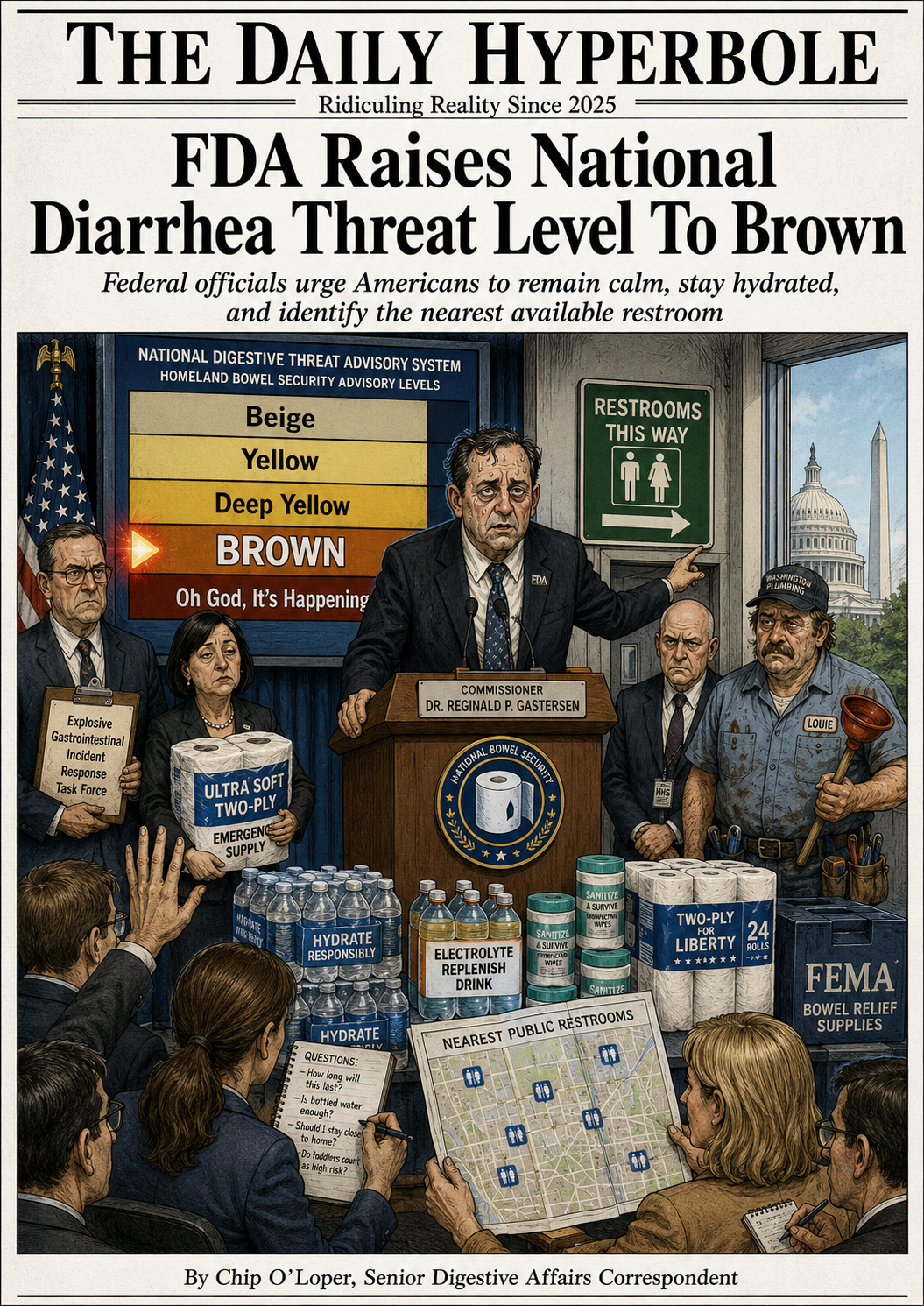
The announcement marked the first time the federal government has activated the Brown Alert System since its creation during a closed-door emergency session at a highway rest stop outside Baltimore.
“We are not asking Americans to panic,” FDA Commissioner Dr. Martin Flushing said during a press conference held suspiciously close to the exit. “We are merely asking them to remain vigilant, wash all produce, stay properly hydrated, and avoid entering any building without first confirming the location of its restroom.”
Officials emphasized that Brown is the second-highest level on the five-tier digestive threat scale, sitting above Beige, Yellow, and Deep Yellow, but below the rarely invoked designation of Oh God, It’s Happening.
The outbreak has been linked to contaminated lettuce served at several restaurants, leaving investigators scrambling to determine how a vegetable consisting primarily of water and disappointment became the most dangerous ingredient on the menu.
“This is why I never trusted salad,” said Ohio resident Mark Denton, who has avoided leafy greens since briefly encountering spinach at a wedding in 2004. “People laughed at me. Who’s laughing now? Not me. Laughing increases abdominal pressure.”
At affected restaurants, customers were advised to shelter near a toilet and avoid unnecessary travel, coughing, sneezing, sudden movements, white pants, and any situation in which someone might casually say, “There’s probably a bathroom when we get there.”
The Federal Emergency Management Agency has reportedly begun distributing bottled water, electrolyte beverages, and industrial quantities of two-ply toilet paper to the hardest-hit communities.
“We have pre-positioned supplies throughout the Midwest,” FEMA Administrator Janet Holloway said. “However, we strongly discourage hoarding. Every American deserves access to toilet paper, including those who bought lettuce believing they were making a responsible choice.”
The White House also announced the formation of an interagency Explosive Gastrointestinal Incident Response Task Force, bringing together representatives from the FDA, CDC, FEMA, Department of Agriculture, Environmental Protection Agency, and one extremely tired plumber from Cleveland.
The task force will be led by newly appointed Diarrhea Czar Lawrence “Skip” Mallory, a longtime Washington official with no medical training but extensive experience managing leaks.
“This administration will pursue a firm, coordinated, and wipe-based response,” Mallory said. “We will get to the bottom of this crisis. Then we will thoroughly clean the bottom of this crisis.”
Congressional leaders quickly divided along party lines over the administration’s response.
Republicans accused federal regulators of failing to protect the nation’s bathrooms, while Democrats called for increased funding for public-restroom infrastructure and a nationwide ban on single-ply paper.
One bipartisan proposal would establish a Strategic Toilet Paper Reserve modeled after the nation’s emergency petroleum stockpile. The reserve would contain enough tissue to support the entire population through four days of moderate intestinal unrest or approximately six hours of widespread Taco Bell exposure.
“We maintain reserves of oil, medicine, and grain,” said Sen. Chuck Tillman, D-Conn. “Yet when Americans face a true emergency, we tell them to check under the sink and hope there’s another roll.”
The FDA has also released updated preparedness guidelines recommending that households maintain at least three days’ worth of water, bland foods, disinfectant, clean clothing, and plausible excuses for abruptly leaving a Zoom meeting.
Employers were encouraged to adopt flexible attendance policies during the outbreak.
“No employee should be forced to choose between their livelihood and attempting to drive 45 minutes during an active gastrointestinal event,” the agency said in a statement. “Remote work remains an essential component of national bowel security.”
Several major corporations have already updated their emergency procedures.
Employees at one consulting firm received an email instructing them to work from home if they experienced symptoms, though the message arrived two days late because management was still determining whether the situation required an official communication.
Restaurant chains, meanwhile, have begun removing suspect lettuce from menus and replacing it with ingredients considered safer, including cheese, sour cream, fried meat, and other substances incapable of supporting life.
Taco Bell denied that the outbreak reflected broader food-safety issues and stressed that the chain has always been transparent about its explosive reputation.
“Our advertising has never concealed the possibility of rapid movement,” the company said. “The phrase ‘Live Más’ should not be interpreted as a guarantee regarding duration or quality of life.”
Federal health officials cautioned that Cyclospora symptoms may persist for days or weeks, distinguishing the parasite from an ordinary meal-related digestive incident, which typically resolves after a brief period of regret and personal reflection.
“You may believe the situation has passed,” CDC epidemiologist Dr. Susan Klein explained. “Then, without warning, the parasite can return. It behaves less like food poisoning and more like a recurring subscription service.”
Investigators continue tracing the outbreak through farms, processing facilities, distribution centers, restaurants, dining tables, and ultimately America’s increasingly overburdened sewer system.
Until the source is fully contained, officials recommend avoiding potentially contaminated produce, washing hands frequently, and treating every suspicious stomach noise as credible intelligence.
At press time, the national diarrhea threat level remained Brown, though officials acknowledged that conditions were moving quickly through the system.