
Man Googles Symptom, WebMD Suggests Both “Dehydration” and “Immediate Death”
By Staff Writer, Hypochondria Research Correspondent
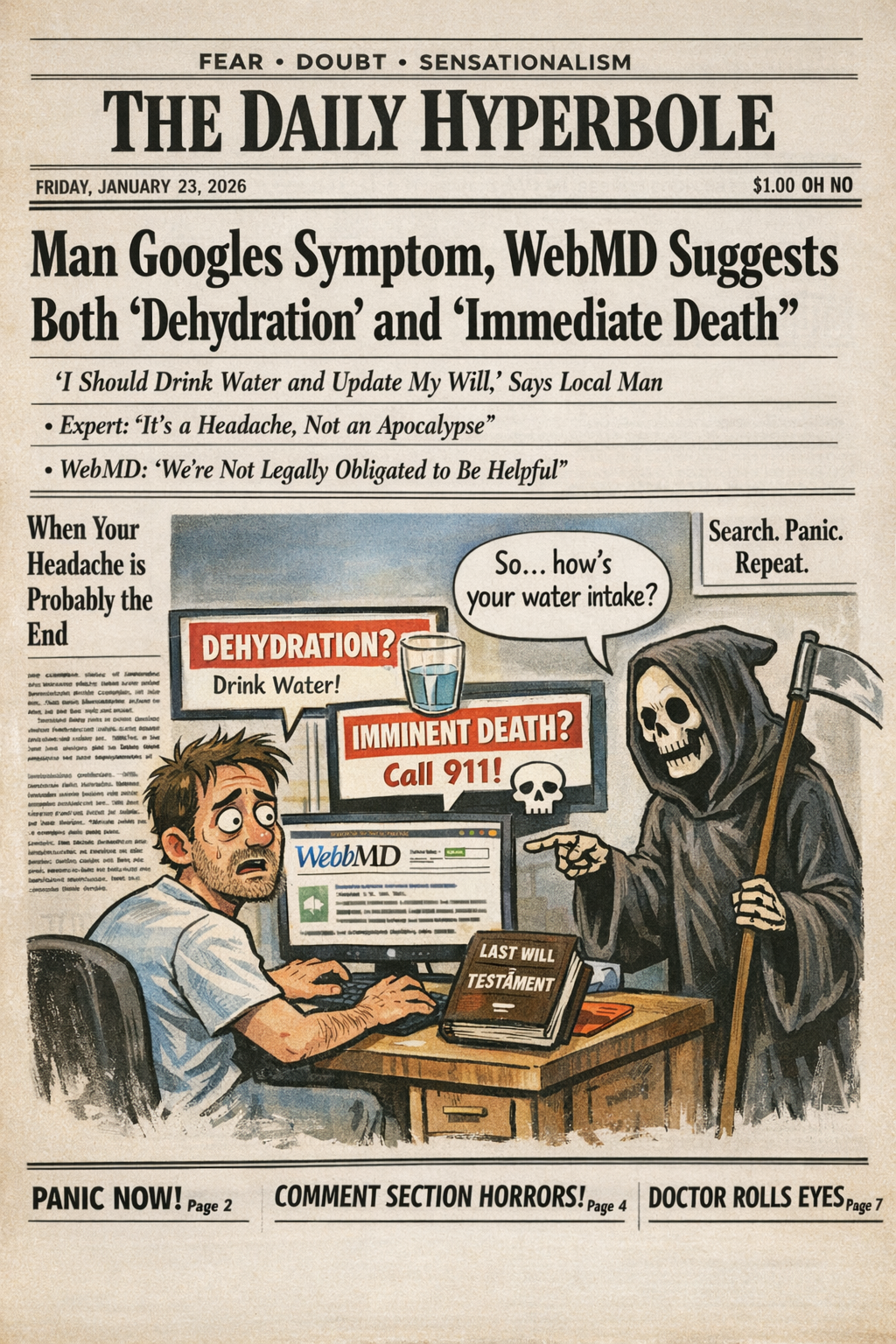
PORTLAND, OREGON — Local software developer Ryan Mitchell, 29, experienced a minor headache Tuesday afternoon and made the critical error of consulting WebMD, which promptly informed him he was either slightly thirsty or actively dying.
“I just wanted to know if I should take an Advil,” Mitchell said from his apartment, where he was simultaneously drinking water and drafting his last will and testament. “Now I’m 60% sure I have a brain tumor and 40% sure I just need electrolytes. The percentages don’t add up, which is somehow making it worse.”
The Descent Into Medical Terror
Mitchell’s journey into internet-induced panic began at 2:47 p.m. when he noticed a dull ache behind his left eye—a sensation he described as “probably nothing” before immediately Googling “pain behind left eye.”
The search returned 847,000 results, ranging from “you need glasses” to “you have approximately six hours to live.”
“The first result said it could be eye strain,” Mitchell explained, scrolling through his browser history. “The second said it could be an aneurysm. The third was an ad for sunglasses. I don’t know what to believe anymore.”
Within minutes, Mitchell had opened 23 browser tabs, each offering increasingly dire explanations for his mild discomfort.
The Symptom Checker: A Choose-Your-Own Medical Emergency
Against his better judgment, Mitchell decided to use WebMD’s symptom checker—a tool designed to help users identify potential health issues, but which primarily functions as a panic attack generator.
After entering “headache” and “pain behind eye,” the system asked a series of increasingly ominous questions:
“Is the pain sharp or dull?” (Dull, but possibly sharp?)
“Does it worsen with movement?” (It might? Hard to say.)
“Do you have a sense of impending doom?” (I didn’t until now.)
The results were swift and contradictory.
“According to WebMD, I either need to drink a glass of water or call 911 immediately,” Mitchell said. “There’s no middle ground. It’s either hydration or hospice.”
The Spiral Continues
Unsatisfied with the ambiguity, Mitchell began cross-referencing his symptoms across multiple medical websites, a decision he later described as “the worst mistake of my life.”
“Mayo Clinic said it could be a tension headache. Harvard Medical said it could be a cluster headache. Some blog called HealthyLiving247 said it was definitely gluten,” Mitchell recounted. “One site suggested I might be allergic to my own thoughts. I don’t even know if that’s medically possible, but now I’m worried about it.”
His search history reveals a rapid descent into increasingly specific diagnoses:
“Can you get a brain tumor from screens”
“How fast do brain tumors grow”
“Brain tumor symptoms but also just tired”
“Am I being dramatic or dying”
“WebMD accuracy rate”
The final search returned mixed results, which did not help.
Expert Medical Opinion vs. Internet Chaos
Dr. Sarah Patel, a primary care physician at Portland Medical Center, reviewed Mitchell’s symptoms via text message from his increasingly concerned girlfriend.
“It’s a headache,” Dr. Patel replied. “Drink water. Take Advil. Get off WebMD.”
When informed that WebMD had suggested multiple terminal conditions, Dr. Patel reportedly sighed audibly.
“WebMD is designed to cover all possibilities,” she explained. “Which means it includes everything from ‘you’re fine’ to ‘you’re dead.’ It’s like asking a Magic 8-Ball about your health, except the Magic 8-Ball is legally required to mention cancer.”
Dr. Patel noted that roughly 70% of her patients arrive already convinced they have something they absolutely do not have.
“Last week someone came in convinced they had a rare tropical disease,” she said. “They live in Oregon. They’ve never left Oregon. The disease doesn’t even exist here. But they read about it online, so now I’m testing for it.”
The Comments Section: Where Hope Goes To Die
Mitchell’s anxiety peaked when he ventured into a medical forum’s comments section, where anonymous users shared personal experiences.
“One person said they had the same symptom and it was nothing,” Mitchell said, briefly relieved. “Then another said they had the same symptom and now they can’t eat solid foods. I don’t know which one I’m supposed to identify with.”
The forum featured contributors ranging from licensed physicians to “guys who watched two episodes of House and now have strong opinions about lupus.”
“Everyone was very confident,” Mitchell noted. “Even the people who were completely wrong.”
The Girlfriend Intervention
Mitchell’s girlfriend, Emma Torres, arrived home at 5:15 p.m. to find him lying on the couch with a wet washcloth on his forehead, his laptop open to an article titled “20 Headaches That Could Kill You.”
“He looked like he was on his deathbed,” Torres said. “I asked if he’d taken anything for it. He said no, because he wasn’t sure if Advil would interact with his potential brain tumor.”
Torres confiscated the laptop and handed him a glass of water.
“The headache went away in ten minutes,” she said. “He was dehydrated. That’s it.”
The Aftermath
Despite the symptoms resolving, Mitchell remained convinced he had narrowly avoided disaster.
“Just because it went away doesn’t mean it wasn’t serious,” he insisted. “WebMD said dehydration can be fatal if untreated. I treated it just in time. I basically saved my own life.”
When reminded he had simply consumed water, Mitchell remained unconvinced.
“That’s what they want you to think,” he said.
WebMD Issues Statement
In response to questions about diagnostic accuracy, WebMD released a brief statement:
“Our symptom checker is designed to provide information, not replace professional medical advice. If you are concerned about your health, please consult a doctor—not a website that also runs ads for toenail fungus cream.”
The statement did not address why hiccups are listed alongside “rare neurological disorder.”
Moving Forward
Mitchell says he has learned his lesson and will never Google symptoms again—a promise he has made four times in the past six months.
“I’m done with WebMD,” he declared. “From now on, if something hurts, I’m just going to assume it’s fine and ignore it like a normal person.”
He then immediately Googled “is it bad to ignore headaches.”
At press time, Mitchell was scheduling a doctor’s appointment for next month while remaining convinced he would not survive until then. The headache has not returned. The anxiety has.