
Area Woman Makes Awkward Eye Contact With Man She Rejected On Morning Commute
By Dr. Cassandra Mockingbird
Senior Correspondent for Public Humiliation & Transit Affairs
CAMBRIDGE, MA —
A local woman’s Tuesday morning commute took a dramatic turn after she accidentally made direct eye contact with a man she recently rejected, forcing both parties to acknowledge, for approximately 1.7 seconds, that they are still alive and using the same public transportation system.
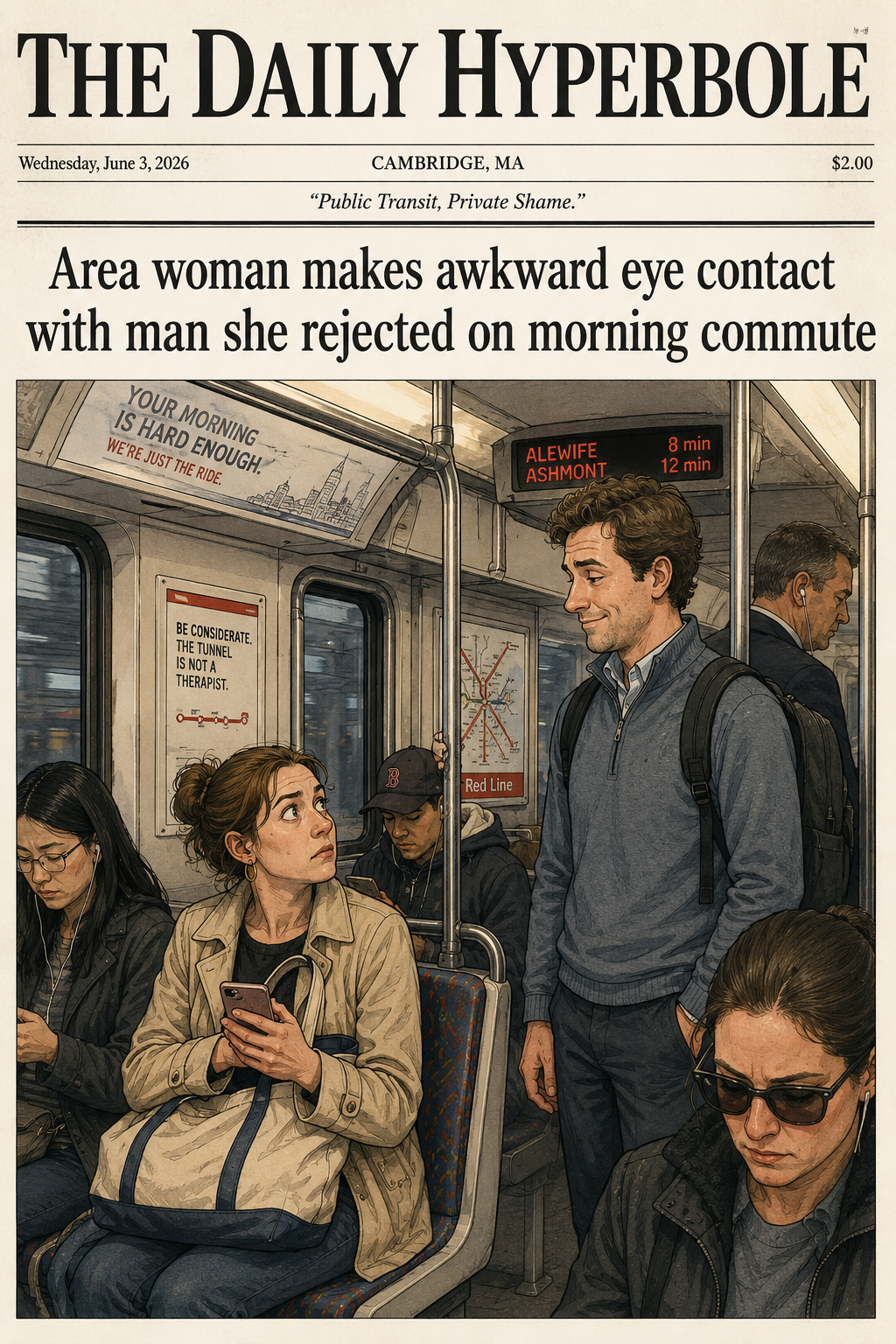
The woman, identified only as “Maddie,” reportedly noticed the man standing near the doors of the train while she was attempting to conduct a normal commute consisting of staring at her phone, pretending not to hear other people’s conversations, and emotionally preparing to answer emails.
Unfortunately, fate had other plans.
“I looked up for literally one second,” Maddie told reporters. “One second. And there he was. Just standing there. Existing.”
Witnesses say the man, identified by commuters as “some guy in a quarter-zip who looked like he had once asked someone to get drinks,” appeared to recognize Maddie immediately. Both parties then engaged in what transit officials are calling “a mutually devastating micro-interaction.”
According to passengers, the encounter began when Maddie glanced up from her phone and locked eyes with the man she had politely but firmly rejected several weeks earlier after what sources described as “a date that was technically fine, but not something she wanted to repeat for the rest of her life.”
The man reportedly gave a small nod, which experts confirmed contained several layers of meaning, including “I remember,” “No hard feelings,” “This is unbearable,” and “I hope you noticed I am doing well.”
Maddie responded with what one witness described as “a closed-mouth commuter smile,” the kind typically reserved for coworkers seen at Trader Joe’s, neighbors whose names you forgot, and people you once shared emotionally ambiguous texts with.
“It was brutal,” said fellow passenger Meredith Cobb, who observed the entire exchange while pretending to read an article about protein intake. “You could tell they both wanted to disappear, but the Red Line does not offer that service.”
Sources close to Maddie say she rejected the man after he sent a follow-up text saying he had “a really nice time” and would “love to do it again sometime,” a message she stared at for two full business days before replying, “You’re really great, but I don’t think I’m feeling a romantic connection.”
The man allegedly responded, “Totally understand! Wishing you the best,” a text that relationship analysts now believe may have been legally binding, but did not account for future accidental eye contact on public transit.
“At the time, I thought that was the end of it,” Maddie said. “I didn’t realize we would both continue living in the same metropolitan area.”
Commuters reported that after the eye contact, both parties immediately looked away in opposite directions with the synchronized precision of Olympic divers. Maddie then became deeply interested in an advertisement for a dental practice, while the man appeared to study the tunnel wall as if it contained answers.
The tension intensified when the train stopped between stations, trapping both individuals in what one MBTA spokesperson called “an unavoidable chamber of romantic aftermath.”
“We regret the inconvenience,” the spokesperson said. “But unfortunately, our trains occasionally hold two people who briefly dated, almost dated, or experienced asymmetric emotional momentum. This is a known service issue.”
At one point, the man reportedly adjusted his backpack in a way that suggested he might move closer to the doors, briefly causing Maddie to prepare for a possible verbal exchange. However, he remained exactly where he was, choosing instead to stare at his reflection in the train window and reconsider every life choice that had brought him to this moment.
“I was ready to say ‘Hey, how are you?’ if necessary,” Maddie explained. “But I was praying it would not become necessary.”
Experts say the incident is part of a larger trend in urban dating, where rejection no longer guarantees closure due to the rising likelihood of seeing someone again in coffee shops, grocery stores, office buildings, climbing gyms, and commuter rail platforms.
“Modern dating creates the illusion that you can politely end things and move on,” said Dr. Lenora Wilkes, a sociologist specializing in romantic residue. “But if you both live within three stops of each other, the city will eventually schedule a mandatory emotional audit.”
By the time Maddie reached her stop, witnesses say she exited the train with the careful urgency of someone trying not to look like she was fleeing. The man remained onboard, reportedly checking his phone despite having no notifications.
Maddie later confirmed that the interaction “wasn’t that bad,” before admitting she had already changed her commute route for the next morning.
“I know it’s immature,” she said. “But there’s another train eight minutes later, and I think healing requires boundaries.”
At press time, Maddie had made brief eye contact with a different man she had matched with on Hinge but never responded to, prompting her to consider working from home indefinitely.