
America Marks 250th Birthday By Asking Cashiers To Break A $250
By Thurston P. Bootstrap IV
Senior Commemorative Currency Correspondent
WASHINGTON, D.C. — In a bold tribute to 250 years of American independence, Treasury officials confirmed Thursday that the nation may celebrate its semiquincentennial by introducing a commemorative $250 bill and then immediately asking the most underpaid workers in the country to decide whether it is real.
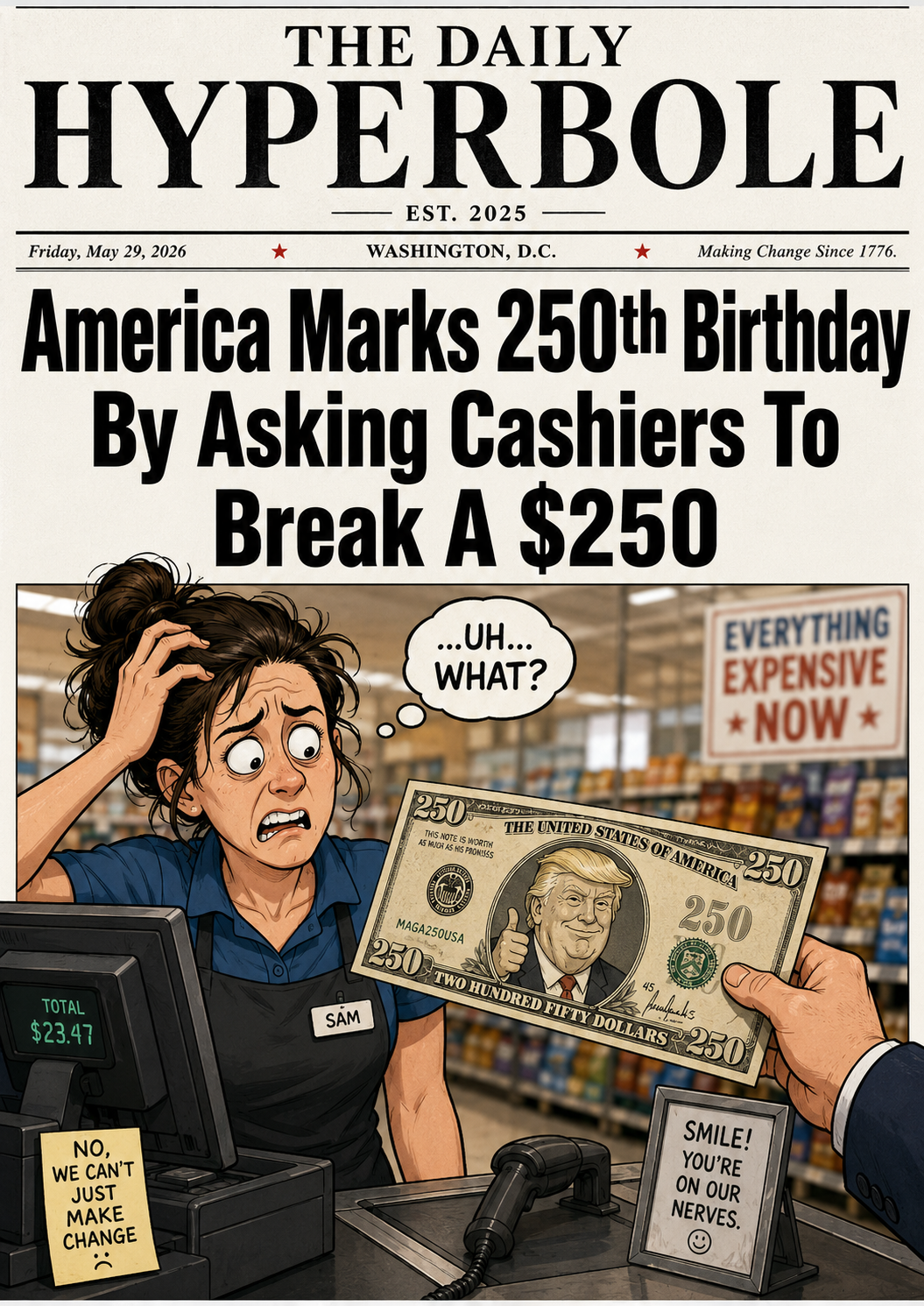
The proposed bill, expected to feature President Donald Trump, would commemorate the 250th anniversary of the Declaration of Independence while also honoring America’s proud tradition of handing a cashier something weird and saying, “You can take this, right?”
“This is exactly what the Founders envisioned,” said one Treasury official, carefully placing a laminated prototype of the $250 bill into a frame labeled LEGAL TENDER, PENDING VIBES. “When Thomas Jefferson wrote that all men are created equal, he was clearly referring to the equal panic felt by a gas station clerk, a bank teller, and a teenage smoothie-shop employee when presented with a denomination nobody has ever seen before.”
The Treasury Department has reportedly prepared designs for the bill in case Congress approves legislation allowing Trump’s image to appear on the note. Current federal law prohibits living people from appearing on U.S. currency, meaning lawmakers would first need to create an exception before Americans can begin arguing with CVS employees about whether the bill is “basically money.”
Supporters say the $250 bill is a fitting tribute to America’s 250th birthday, noting that no national celebration is complete until it produces a confusing object that only collectors, cable news hosts, and one uncle at Thanksgiving fully understand.
“This bill represents America,” said Rep. Alan Brackett, a fictional lawmaker from Ohio who asked to be paid for the interview in commemorative quarters. “It’s patriotic, impractical, legally complicated, and will almost certainly be sold on late-night television in a velvet display case.”
Retail workers across the country reacted with the quiet dread of citizens who suddenly realized they may soon be responsible for adjudicating monetary policy at register three.
“I already have to tell people we don’t accept $100 bills before 9 a.m.,” said Denise Miller, a Walgreens cashier in Virginia. “Now I’m supposed to look at a $250 bill with Trump’s face on it and decide whether this is currency, campaign merchandise, or a felony?”
Miller said she plans to handle the new bill the same way she handles all unusual customer requests: by calling over a manager who is “technically on break but emotionally never off duty.”
Economists praised the bill’s potential to simplify highly specific transactions, including the purchase of one pair of sneakers, two concert tickets with fees, half a week of groceries, or one urgent care visit where the doctor says, “It’s probably viral.”
“From a macroeconomic standpoint, the $250 bill fills a crucial gap between the $100 bill and the feeling of being financially assaulted,” said Dr. Meredith Klein, a monetary policy expert at Georgetown. “For too long, Americans have been forced to pay for overpriced goods using multiple normal bills, a credit card, or quiet despair. This solves none of that, but it does add spectacle.”
The bill has already inspired fierce debate among historians, legal experts, and men in wraparound sunglasses who believe every commemorative item becomes valuable if you keep it in plastic long enough.
Critics argue that placing a living president on currency would violate a longstanding tradition designed to prevent America’s money from becoming a rotating tribute wall for whoever currently controls the executive branch. Federal restrictions on living people appearing on U.S. currency date back to the 19th century, though supporters of the proposal insist the law is merely “old,” “negative,” and “probably jealous.”
When asked whether creating a $250 bill might confuse consumers, one administration official dismissed the concern.
“Americans are very financially literate,” the official said. “They understand interest rates, tariffs, crypto wallets, airline fees, and why a sandwich now costs $19. We are confident they can handle one more number.”
Retail associations have requested clear guidance before the bill enters circulation, including whether stores are allowed to refuse it, whether cashiers should hold it up to the light, and whether managers are legally required to say, “I’ve never seen one of these before,” before accepting it.
At press time, the Treasury Department was reportedly testing whether vending machines could accept the new bill, though early results showed most machines simply displayed the message: PLEASE INSERT MONEY FROM THIS TIMELINE.