
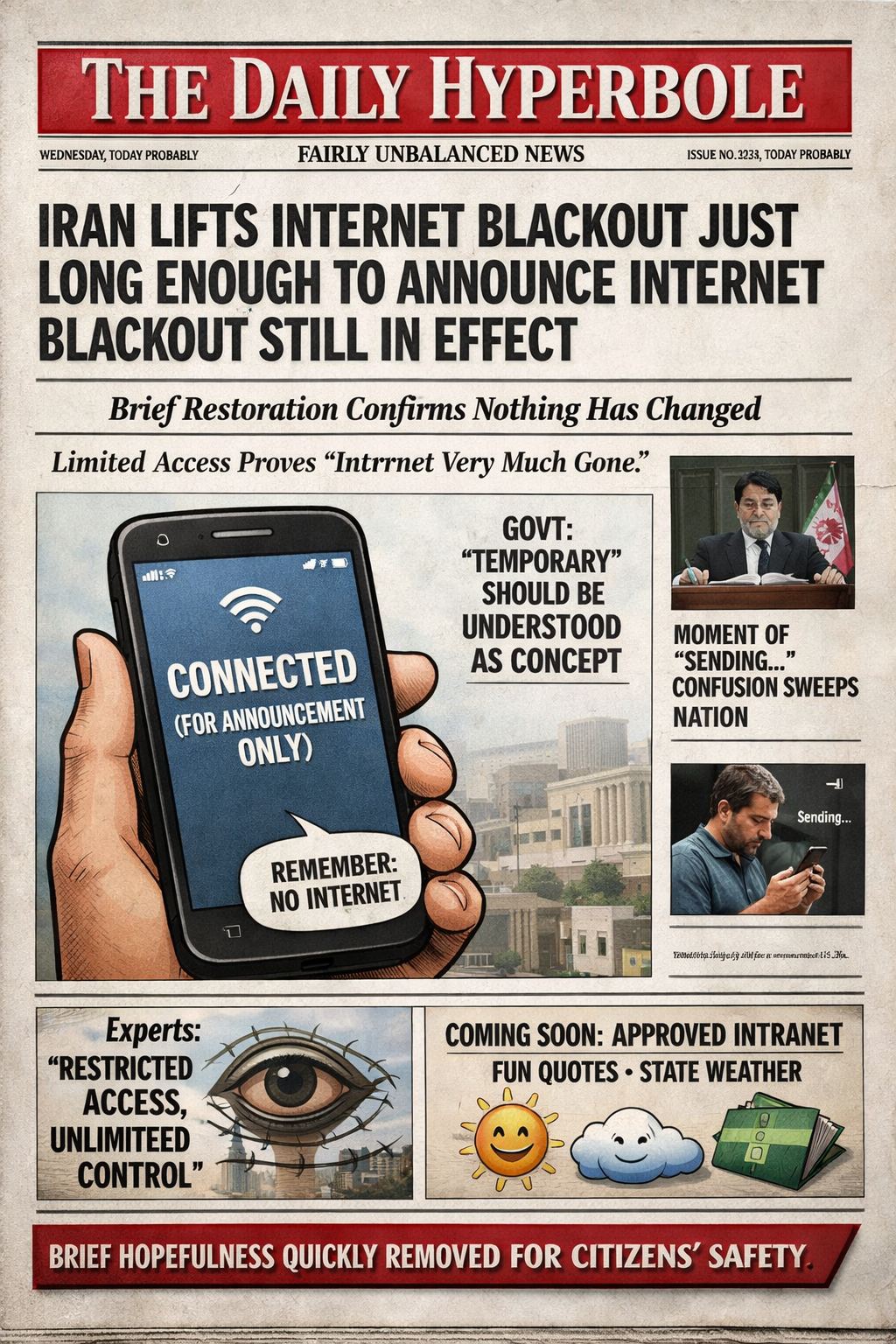
Iran Lifts Internet Blackout Long Enough to Announce Internet Blackout Still In Effect
Brief Restoration Confirms Nothing Has Changed
By Staff Writer, Seeing “No Service” With Fresh Hope
TEHRAN — Iranian officials briefly restored limited connectivity Tuesday in order to reassure the public that the nationwide internet blackout remains firmly in place, according to citizens who experienced several confusing seconds of optimism before reality reasserted itself.
The temporary lift, which lasted just long enough for state media to announce it, allowed some users to place international phone calls—a move authorities described as “proof that communications are not fully restricted,” despite the continued absence of messaging apps, social media, mobile data, or anything resembling the internet as it is commonly understood.
“This should not be interpreted as the internet being back,” said one government spokesperson. “The internet is very much gone. This was simply an announcement about the internet being gone, delivered via a brief suspension of the internet being gone.”
Residents across the country reported momentary signs of life on their phones, including notification icons that never loaded, messages permanently marked sending, and the deeply unsettling sensation that something almost worked.
“I thought my phone was broken,” said one Tehran resident. “Then I realized it was working exactly as intended.”
According to the Ministry of Communications, the decision to briefly restore limited services was part of a broader effort to promote clarity.
“We believe it is important for citizens to understand that they do not currently have access to the internet,” said Deputy Minister of Communications Reza Mahdavi. “By allowing them to briefly experience something resembling access, we were able to effectively communicate that they should not expect it.”
Mahdavi added that the blackout remains “necessary, temporary, and subject to change,” clarifying that temporary should be understood as a concept rather than a timeline.
State television praised the move as a balanced approach that allows citizens to contact relatives abroad while preventing the spread of unauthorized information, videos, eyewitness accounts, or anything else that might interfere with the official version of events.
Experts say the strategy reflects a growing trend in modern governance: allowing just enough access to plausibly deny censorship while maintaining total control over what people can actually see.
“It’s very elegant,” said one regional analyst. “People can tell their loved ones they’re safe, but they can’t show anyone why they might not be.”
At press time, officials were reportedly considering further adjustments to connectivity, including allowing citizens to access a government-approved intranet containing weather updates, inspirational quotes, and reminders that everything is under control.
Meanwhile, citizens confirmed the internet remains unavailable, inaccessible, and mostly theoretical—though morale briefly improved upon learning that authorities are actively monitoring the situation by preventing anyone from monitoring the situation.