
U.S. Soccer Announces New Strategy: More Presidential Interference, Less Defending
Written by Thurston P. Bootstrap IV
CHICAGO — Following the United States men’s national team’s devastating 4–1 elimination at the hands of Belgium, U.S. Soccer officials announced Tuesday that the program would be taking a hard look in the mirror and making one major tactical adjustment going forward: significantly more presidential interference and substantially less defending.
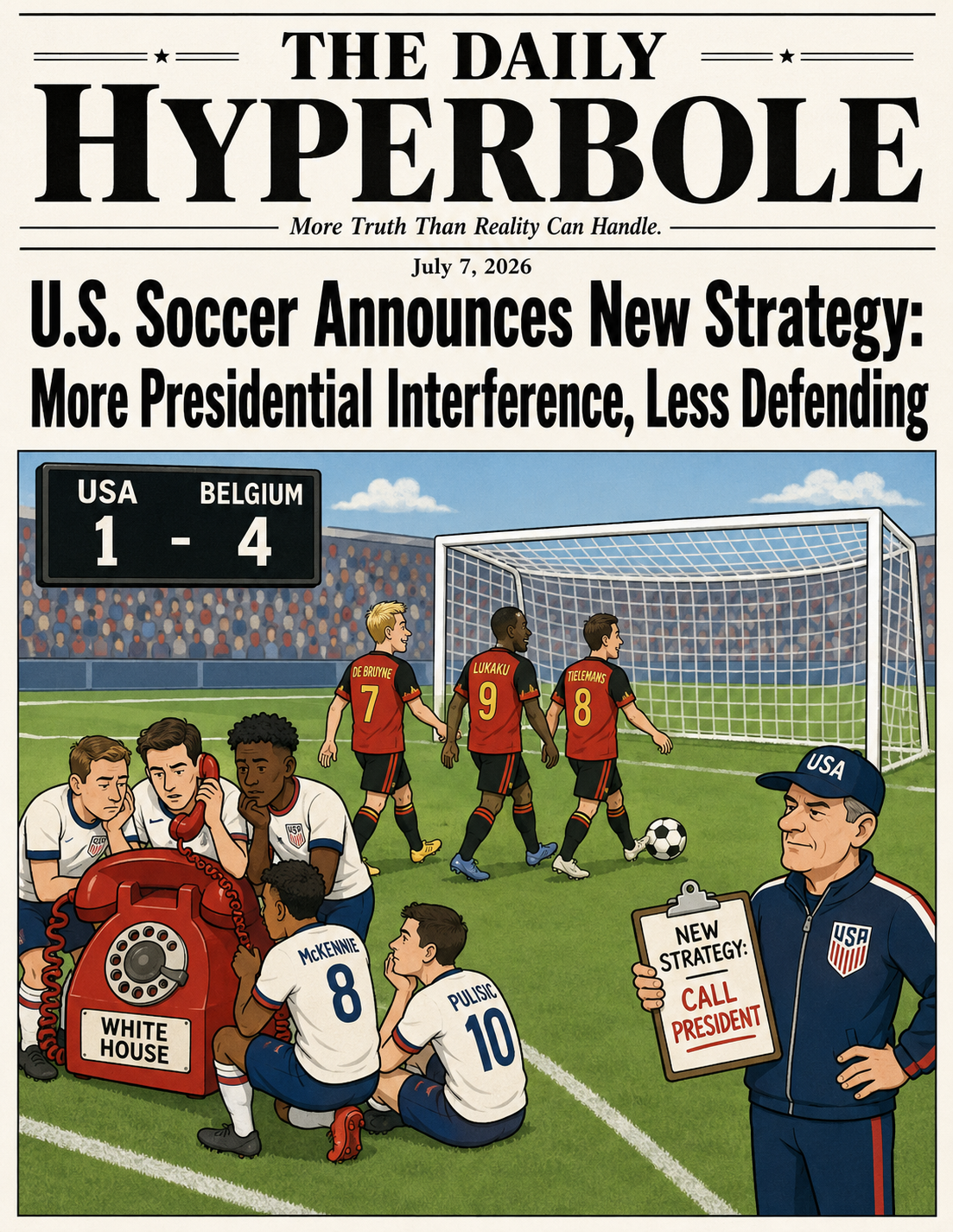
The announcement came less than 24 hours after President Trump reportedly intervened to help get a key American player reinstated before the match, a bold act of executive soccer leadership that resulted in the United States losing by only three goals.
“We have reviewed the tape, we have reviewed the data, and we have reviewed several very angry phone calls from important people,” said U.S. Soccer spokesperson Mark Ellington. “The conclusion is clear: our problem was not defensive shape, midfield control, or marking Belgium’s attackers. Our problem was that the President did not interfere early enough, often enough, or loudly enough.”
According to team officials, the new strategy will involve replacing outdated concepts such as “tracking runners,” “closing down space,” and “not conceding four goals” with a modernized approach centered on executive pressure, emergency rule reinterpretation, and asking FIFA if anything Belgium did can be made retroactively illegal.
“We are entering a new era of American soccer,” Ellington continued. “For too long, other nations have relied on technical skill, tactical discipline, and player development. We now believe the American path forward is calling the governing body repeatedly until someone gets uncomfortable.”
Sources within U.S. Soccer say the revised tactical plan, tentatively titled Project Executive Overlap, will feature the President in a free-roaming administrative role, allowing him to drift between the referee’s office, FIFA headquarters, and Truth Social depending on where the match needs him most.
Early drafts of the plan reportedly include several key innovations, including a “Presidential VAR Room,” a “Strategic Tariff On Belgian Counterattacks,” and a new formation known as the 4-3-3-Phone Call.
Under the 4-3-3-Phone Call, four defenders will stand near midfield while waiting for legal clarification, three midfielders will point at the referee, three forwards will gesture toward the White House box, and one senior administration official will demand to know whether Belgium’s goals were properly certified.
Team analysts were particularly encouraged by the potential of the new system, noting that the United States looked most dangerous whenever Belgium had already scored and there was nothing left to lose.
“Belgium had a very old-fashioned approach,” said one U.S. Soccer technical advisor. “They tried to pass, move, create chances, and put the ball in the net. That may work in Europe, but here in America we believe matches should be decided through a transparent appeals process overseen by someone with strong opinions about television ratings.”
The White House, for its part, praised the team’s effort and insisted the final score did not accurately reflect the President’s performance.
“President Trump did everything right,” said one senior administration official. “He got involved, he made the call, he stood up for America, and frankly, without him, we might have lost 4–0. People forget that. They only focus on the three-goal loss, not the one goal he personally made possible.”
When asked whether the President accepts any responsibility for the defeat, the official shook his head.
“You cannot blame the President for Belgium scoring four goals. He was not on the field. If he had been, believe me, many people are saying Belgium would not have wanted to attack that much.”
Belgian players appeared amused by the situation after the match, with one reportedly asking whether the United States planned to appeal the scoreboard, the clock, or simply the existence of Belgium.
“We were told there was some political controversy before the game,” said Belgian midfielder Pieter Van Dijk. “But once the match started, we mostly focused on running toward the large empty spaces where the American defenders were not.”
That comment reportedly enraged U.S. Soccer officials, who immediately added “defending large empty spaces” to the list of outdated European concepts the program hopes to move beyond.
Still, some critics questioned whether the new approach goes far enough. Several former players argued that U.S. Soccer should also consider interfering in opponents’ substitutions, demanding congressional hearings on offsides, and appointing a Secretary of Set Pieces.
“At the end of the day, this is about accountability,” said former national team defender Chris Barlow. “And accountability means finding out who allowed Belgium to keep scoring after the President had already made his position very clear.”
U.S. Soccer confirmed that preparations for the next World Cup cycle are already underway, with the federation expected to hire a new Director of Presidential Match Operations by the end of the month.
The ideal candidate, according to the job posting, must have five years of experience in international soccer, crisis communications, and pretending a 4–1 loss is actually a sign of institutional strength.
Meanwhile, the team’s coaching staff has reportedly been instructed to spend less time drilling defensive transitions and more time rehearsing phrases such as “this result is under review,” “we are exploring all available remedies,” and “the President has been briefed.”
Asked whether the United States would eventually need to improve at soccer itself, Ellington said the federation remains open to all possibilities.
“Of course we want to develop better players,” he said. “But player development takes years. Presidential interference can happen immediately. And in American sports, that kind of efficiency matters.”
At press time, FIFA officials had reportedly stopped answering calls from Washington, while U.S. Soccer released a statement insisting the Belgium match was “not a loss, but a heavily disputed diplomatic setback with excellent television numbers.”