
Experts Praise Iran Peace Deal As Bold First Step Toward Next Iran War
By Thurston P. Bootstrap IV
Senior Conflict Resolution Futurist
WASHINGTON, D.C. —
Foreign policy experts across Washington praised the newly announced Iran peace deal Monday, calling it “a historic breakthrough” and “an essential first step toward establishing the conditions necessary for the next Iran war.”
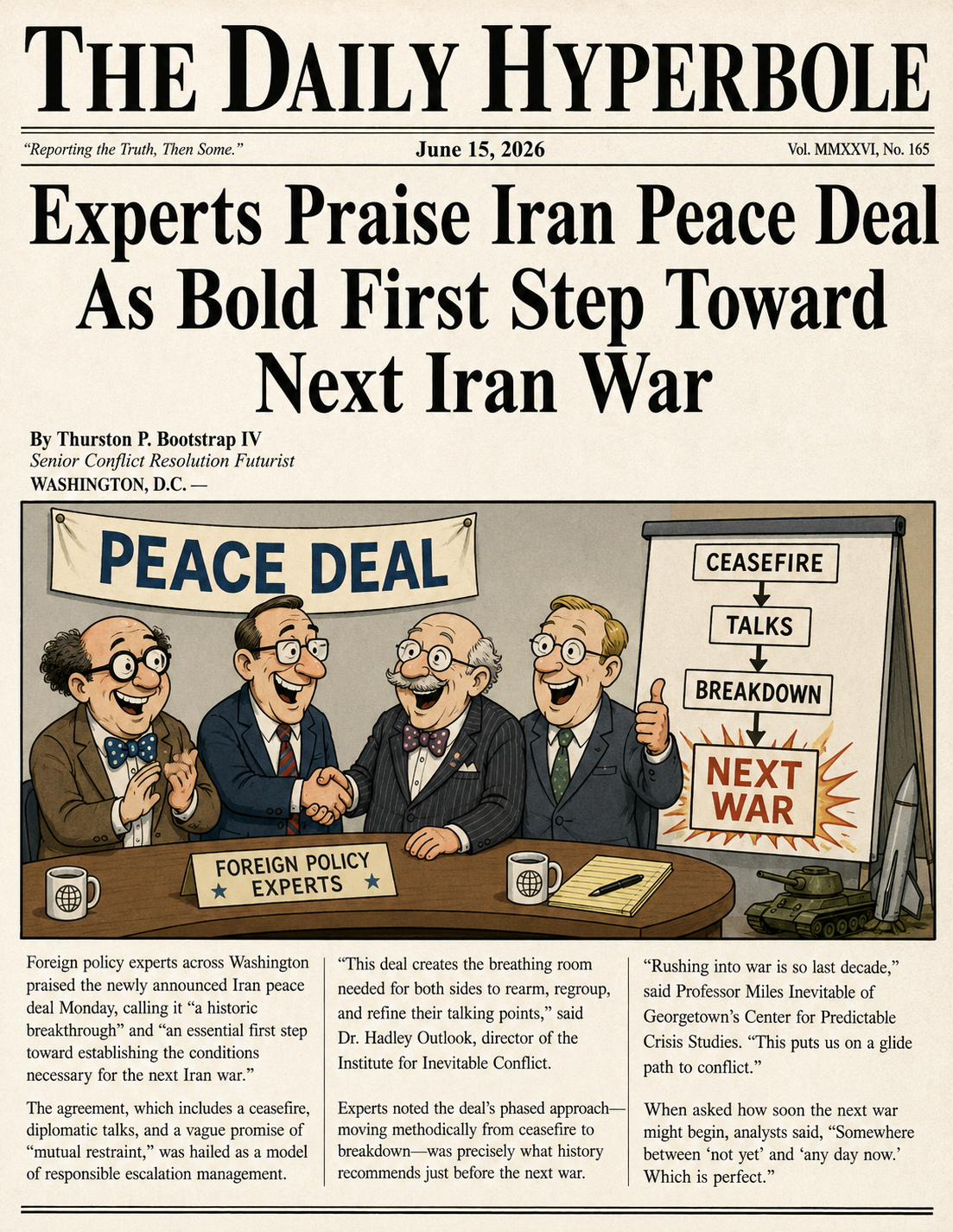
The agreement, which reportedly includes a ceasefire, the reopening of the Strait of Hormuz, and further talks on Iran’s nuclear program, was welcomed by diplomats as a major achievement in the long and noble tradition of ending one war just in time to begin preparing for another.
“This is exactly how durable peace begins,” said Dr. Malcolm Bridgewater, senior fellow at the Center for Strategic Delay. “First, both sides stop shooting. Then they disagree about what they agreed to. Then allies feel betrayed, hardliners denounce the deal, sanctions become complicated, inspectors get yelled at, and before you know it, we’re back to the beautiful simplicity of airstrikes.”
Officials described the deal as “comprehensive,” while quietly acknowledging that several minor details remain unresolved, including nuclear enrichment, sanctions relief, ballistic missiles, regional proxies, shipping guarantees, Israeli objections, frozen assets, verification mechanisms, and whether anyone involved actually trusts anyone else. Analysts noted that this left only “the entire point of the agreement” to be finalized at a later date.
“This deal proves diplomacy works,” said one State Department official. “Specifically, it works as a temporary filing system for problems too explosive to solve today.”
Markets responded positively to the news, with oil prices falling as investors celebrated the possibility that global energy supplies may remain stable until approximately the next press conference. Shipping executives also welcomed the reopening of the Strait of Hormuz, though several admitted they were “not emotionally ready” to base the world economy on everyone continuing to behave normally in the Persian Gulf.
At the Pentagon, officials expressed cautious optimism, confirming that while the peace deal was encouraging, contingency plans for future conflict had already been updated under the file name IRAN WAR 2 — FINAL FINAL REVISED PEACE VERSION.
“This is not a failure,” said retired General Buck Harrow, now a defense consultant. “This is Phase One of a mature geopolitical cycle: strike, negotiate, celebrate, accuse, sanction, escalate, repeat.”
Iranian officials also praised the agreement, calling it a victory for national sovereignty, regional dignity, and getting the United States to stop bombing things long enough to reopen trade routes. American officials, meanwhile, called it a victory for peace, strength, leadership, and not having to explain gas prices for at least several days.
Asked whether the deal would last, experts were divided. Some predicted it could hold for months. Others were more optimistic, saying it might collapse much sooner, thereby avoiding a long and confusing period of false hope.
“This is the most promising Iran peace deal we’ve seen since the last promising Iran peace deal,” said Bridgewater. “And like all great peace deals, it gives every party just enough victory language to accuse the other side of betrayal.”
At press time, world leaders were urging restraint, good faith, and immediate preparations for the emergency summit that will be required when all of this becomes someone else’s fault.