
America Renews Iran War Subscription After Free Ceasefire Trial Expires
WASHINGTON, D.C. — The United States has officially renewed its premium war subscription with Iran after allowing a complimentary ceasefire trial to expire, White House officials confirmed Thursday.
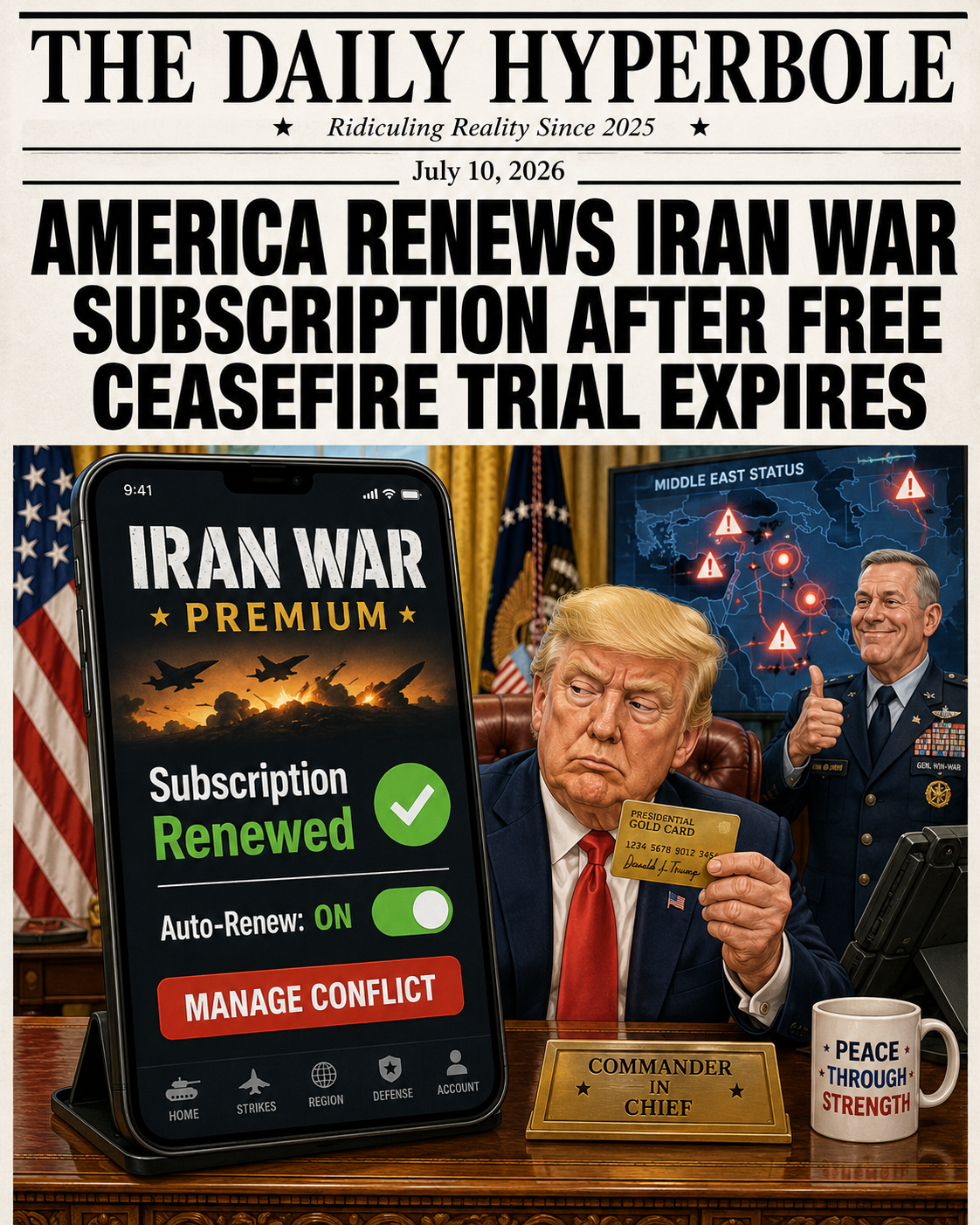
The ceasefire, which provided users with limited access to diplomacy, reduced bombing and several exclusive “regional stability” features, ended automatically after government officials failed to cancel before the renewal date.
“We thought someone had turned off auto-renew,” said one senior administration official, frantically searching the White House shared inbox for a confirmation email. “Apparently, the ceasefire was only free for the first few weeks. After that, it defaults back to full-scale hostilities.”
President Donald Trump announced that the temporary agreement was over, explaining that although peace had been “very beautiful” and “possibly the greatest peace anyone had ever seen,” Iran had failed to upgrade to a permanent plan.
“They had a chance,” Trump said. “A very generous chance. Nobody gives chances like me. But they did not accept Peace Plus, so now they are back on War Premium.”
According to Pentagon billing records, the renewed plan includes unlimited airstrikes, expanded naval activity, complimentary missile-defense alerts and access to up to five additional regional conflicts at no extra charge.
The package also comes with 24-hour technical support from defense contractors, although officials warned that wait times may be longer than usual due to exceptionally high global demand.
“We are experiencing a larger-than-normal volume of forever wars,” an automated Pentagon message reportedly told callers. “Your conflict is very important to us. Please remain on the line.”
The original ceasefire had been advertised as a major breakthrough and a possible first step toward lasting peace. But analysts now believe the agreement was structured less like a peace treaty and more like a streaming service promotion designed to lure both countries into briefly experiencing a life without explosions.
“For a few weeks, everyone got to sample diplomacy,” said foreign-policy analyst Deborah Kline. “There were meetings, intermediaries and statements about constructive progress. Unfortunately, diplomacy contains ads unless you purchase the full version.”
Administration officials said the United States attempted to cancel the war through the proper channels but was unable to locate the cancellation button.
“We went into Settings, then Security, then Regional Conflict Preferences,” said Secretary of State Marco Rubio. “There was an option to pause the war, but not to end it. Ending it apparently requires calling a number that is only staffed between 2:00 and 2:15 a.m. Central Asian Time.”
Iranian officials claimed they had also tried to cancel but were repeatedly redirected to Israel.
“Every time we clicked ‘End Conflict,’ a pop-up appeared asking whether we also wanted to unsubscribe from tensions with Israel,” said an Iranian government spokesperson. “Then the page froze.”
Israel, meanwhile, confirmed that it remains included in the broader Middle East Family Plan, which allows multiple countries to share one conflict while maintaining separate grievances.
“It’s convenient,” said an Israeli defense official. “Everybody gets their own targets, their own statements of retaliation and personalized recommendations based on previous military activity.”
The renewed Iran War subscription comes with several new features unavailable during earlier versions of the conflict, including AI-generated escalation warnings, real-time oil-price anxiety and a redesigned Strait of Hormuz interface.
Shipping companies navigating the area will now receive helpful notifications such as: YOUR ROUTE MAY INCLUDE ACTIVE MISSILE ACTIVITY and WOULD YOU LIKE TO PURCHASE WAR-RISK INSURANCE?
Energy markets also received a welcome email thanking them for returning.
“We missed you,” the message reportedly read. “Because you previously enjoyed instability in the Persian Gulf, we thought you might like: dramatically fluctuating oil prices.”
White House officials emphasized that the renewed fighting should not be interpreted as a failure of diplomacy.
“This is actually part of the diplomatic process,” one official explained. “First you negotiate. Then you bomb. Then you negotiate about the bombing. Then you bomb because the negotiations about the bombing broke down. It is a highly sophisticated system.”
Trump agreed, insisting the war was necessary to preserve peace.
“We are bombing for peace,” the president said. “And we will continue bombing for peace until the peace stops resisting.”
Administration spokespeople also rejected comparisons to earlier American wars in the Middle East.
“This is completely different,” said Pentagon representative Maj. Gen. Bradley T. Invoice. “Those were long, expensive military commitments with unclear objectives and shifting definitions of victory. This is a flexible, open-ended security engagement billed monthly.”
Congressional leaders expressed surprise that the subscription had renewed without additional authorization but acknowledged that they had clicked “Accept All” on the original terms and conditions.
“I assumed it was just cookies,” said one senator.
The 4,700-page user agreement reportedly allows the executive branch to renew military operations automatically whenever officials determine that peace has become inconvenient, unstable or insufficiently profitable.
Lawmakers from both parties promised to closely monitor the conflict by appearing on television and asking why no one had consulted them.
Several members of Congress also introduced the Transparent War Billing Act, which would require the Pentagon to clearly disclose all taxes, service charges and civilian casualties before users authorize another military campaign.
The defense industry welcomed the renewal and announced that loyal subscribers would earn double rewards points throughout July.
Customers who authorize three consecutive weapons packages will qualify for a complimentary fourth shipment, while select contractors may receive priority access to the next regional emergency.
“This is our way of saying thank you,” said Raytheon customer-retention specialist Colin Mercer. “We know America has many choices when selecting a war, and we are honored it continues choosing ours.”
At press time, the White House said it remained open to peace negotiations and would consider canceling the subscription as soon as Iran met all conditions, Israel felt completely secure, global shipping returned to normal, oil markets stabilized and every person involved agreed on what the conditions actually were.
Until then, Americans were encouraged to enjoy the benefits of their renewed plan.
Iran War Premium: Now with fewer commercial interruptions and significantly more military ones.